Key Facts
- £1,200-£1,500/week standard live-in care in the UK in 2026 (Helping Hands, 2026)
- £1,298/week average residential care home cost (self-funded) (carehome.co.uk, 2026)
- £1,535/week average nursing home cost (self-funded) (carehome.co.uk, 2026)
- £56,000-£72,000/year saving for couples choosing live-in care over two care home placements (carehome.co.uk, 2026)
- 23.7% average UK care home staff turnover in 2025, down from 35.6% in 2018 (Skills for Care, 2025)
- NHS Continuing Healthcare can fund either setting fully if the primary health need test is met (NHS England National Framework, 2026)
Most UK families comparing live-in care and a care home stop at the headline weekly figures, conclude they're broadly equivalent, and then choose on convenience. The actual cost comparison is closer than the headlines suggest — but for couples it's not even close: one live-in carer covers two people at a single fee, versus two care home placements at £2,596/week combined. That's a £56,000-£72,000 a year difference for the same household, hidden in plain sight.
This piece is the honest comparison families typically can't find — written by an advocate not a provider, with the same cost framework you'd use to compare any other major household financial decision. It covers the singles cost match-up, the couples gap most content ignores, the staff continuity story most cost-only comparisons skip, and what NHS Continuing Healthcare changes when it's awarded for either option.
TL;DR: Live-in care in the UK costs £1,200-£1,500/week in 2026 (Helping Hands, 2026), broadly comparable to a residential care home at £1,298/week or a nursing home at £1,535/week (carehome.co.uk, 2026). For couples, live-in is materially cheaper — one carer covers both partners at a single weekly fee versus two separate care home placements. The right choice depends on care intensity, dementia continuity needs, social-contact needs, and whether NHS Continuing Healthcare funds either option (it can fund both).
How much does live-in care cost vs a care home in 2026?
Live-in care costs £1,200-£1,500/week for standard needs in the UK in 2026, broadly comparable to a residential care home at £1,298/week average for self-funders and a nursing home at £1,535/week (Helping Hands, 2026; carehome.co.uk, 2026) — but for dementia or complex cases, live-in tracks at £1,400-£1,700/week (or £1,800+ for advanced needs), often coming out cheaper than specialist dementia care homes at £1,500-£1,700/week.
Side-by-side cost comparison (UK averages, 2026)
| Setting | Weekly cost | Annual cost |
|---|---|---|
| Live-in care — standard | £1,200-£1,500 | £62,400-£78,000 |
| Live-in care — dementia | £1,400-£1,700 | £72,800-£88,400 |
| Live-in care — complex/advanced | £1,800+ | £93,600+ |
| Residential care home (self-funded avg) | £1,298 | £67,496 |
| Nursing home (self-funded avg) | £1,535 | £79,820 |
| Specialist dementia care home | £1,500-£1,700 | £78,000-£88,400 |
For singles, the four numbers tell the same story: roughly £1,300 to £1,600 a week, regardless of setting. The pricing logic differs (a care home prices a room plus staff per resident; live-in care prices a single carer's time) but the market has converged. What's hidden in the chart is the two-person economics — covered in the next section — and the quality differences that aren't visible in any cost comparison.
Hidden costs sit on both sides. Live-in care typically includes the carer's food and accommodation in the weekly fee (the carer eats with the household) but excludes home utilities — heating, electricity, council tax all stay with the cared-for person. Care homes typically bundle everything into the weekly fee but add top-up fees if the family chooses above the local authority "usual cost" rate, plus extras for hairdressing, chiropody, transport to appointments, and sometimes named GP attendance.
Is live-in care cheaper for couples?
Yes — materially. One live-in carer covers a couple at a single weekly fee of £1,200-£1,500 (occasionally up to £1,600 with a small couples uplift), versus two separate care home placements averaging £2,596/week combined (carehome.co.uk, 2026) — a £56,000-£72,000/year saving. This is the single biggest financial argument for live-in care, and it's almost entirely missing from top-ranking cost comparisons.
Couples cost matrix (UK 2026)
| Arrangement | Weekly cost | Annual cost | Vs two care home placements |
|---|---|---|---|
| 1 live-in carer for couple | £1,400 (midpoint, couples uplift) | £72,800 | −£62,192/year |
| 2 separate care home placements (residential) | £2,596 (£1,298 × 2) | £135,000 | — (baseline) |
| 1 live-in carer + 1 care home placement | £2,648 (£1,400 + £1,298) | £137,696 | +£2,696/year |
| 2 separate nursing home placements | £3,070 (£1,535 × 2) | £159,640 | +£24,640/year |
The structural reason care homes don't typically accommodate couples on a 1-fee basis is room availability and care-needs mismatch. Most care home rooms are single-occupancy, and even where double rooms exist, both partners are usually charged separate fees because each requires their own care-needs assessment and care plan. The few care homes offering "couples suites" tend to charge a 30-50% premium on top of two individual fees, taking the effective cost beyond two ordinary placements.
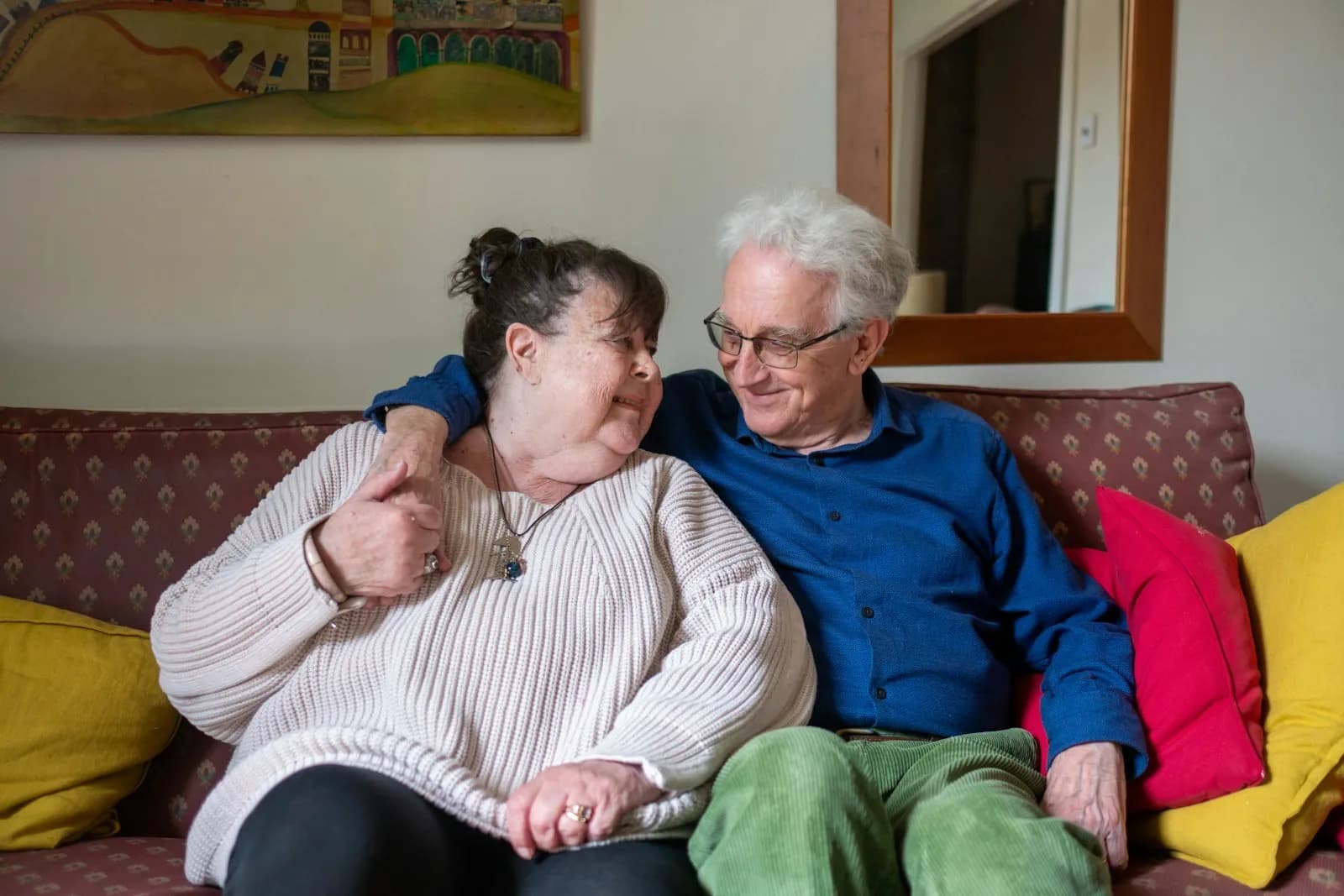
There's a non-financial argument that often weighs more heavily than the £62,000-a-year figure. Separating couples who have lived together for forty or fifty years is documented as accelerating cognitive and physical decline in the partner who moves first, particularly where there's any form of dementia involved. Live-in care preserves the cohabitation that most long-married couples treat as foundational, and it's frequently the single deciding factor once a family understands the option exists.
Case study: Mr & Mrs J, dementia, live-in choice
Anonymised here as Mr & Mrs J, a couple in their early eighties, both with mild dementia, faced a choice in late 2024: two care home placements at a combined £2,520/week, or one live-in carer at £1,400/week (the small couples uplift over the standard £1,300 rate). Their daughter ran the numbers and a £58,000-a-year difference was the deciding factor — but more important was that they'd been married 54 years, and the daughter couldn't see them being separated.
The first 18 months worked well. The same primary carer (with a second on rotation) lived in their home and managed daily care for both. Mr J's dementia progressed faster than expected — by mid-2026 he was having behavioural episodes overnight that the single live-in carer couldn't safely manage alone. The family transitioned him to a specialist dementia care home and kept Mrs J on a reduced live-in package (£1,150/week — single rate). At that point they also opened a CHC application for Mr J, which succeeded at month 22 and took his care home fees to zero.
Net financial result over the 22-month live-in period: roughly £107,000 saved versus the two-care-home alternative, and 18 of those 22 months were time together in their own home that wouldn't otherwise have existed. The daughter described it afterwards as "the best £58,000 I never spent."
What does live-in care actually look like day-to-day?
A live-in carer moves into the cared-for person's home, typically working in 2-4 week rotations with a second carer providing relief — delivering 24-hour cover for personal care, medication, household tasks, companionship, and emergency response, with a guaranteed 2-hour daily break and 8 hours' overnight sleeping rest mandated under the Working Time Regulations 1998. The model is structurally different from a hospital or care home staffing pattern — it's built around a relationship with one named primary carer, not a team.
The typical staffing pattern
- Carer 1 lives in for 2-4 weeks, then rotates out for the same period
- Carer 2 lives in during Carer 1's break, then rotates out
- Both carers are named, vetted, and known to the family
- Each carer typically has a single full day off per week (covered by Carer 2, family, or a private hourly carer)
- The 2-hour daily break is usually mid-afternoon when the cared-for person is independent or resting
What's included in the weekly fee
- Personal care (washing, dressing, toileting, continence)
- Medication prompting and administration (where the carer is trained for it)
- All meals and cooking
- Light household tasks (laundry, daily cleaning, shopping)
- Companionship and emotional support
- Attendance at appointments (with transport often charged separately)
- Carer's food and accommodation (the carer eats with the household)
What's not included
- Heavy household cleaning (deep cleans, gardening, window cleaning)
- Medical nursing tasks beyond medication (wound care, injections — community nurses handle these)
- 24-hour active care if needed (single live-in carer must sleep at some point)
- Major decisions outside the care plan (legal, financial — family or attorney's role)
- Council tax, utilities, home insurance (these stay with the cared-for person)
The model breaks down at the same point a hospital ward or care home staffing model would: when the cared-for person needs active care continuously, including overnight. At that point families typically upgrade to a two-carer package (£2,400-£2,800/week) or waking nights (£260+ per night on top of the day fee). For most early-to-moderate dementia and most general frailty, a single live-in carer with the sleeping overnight break is structurally sufficient.
What does a UK care home provide that live-in doesn't?
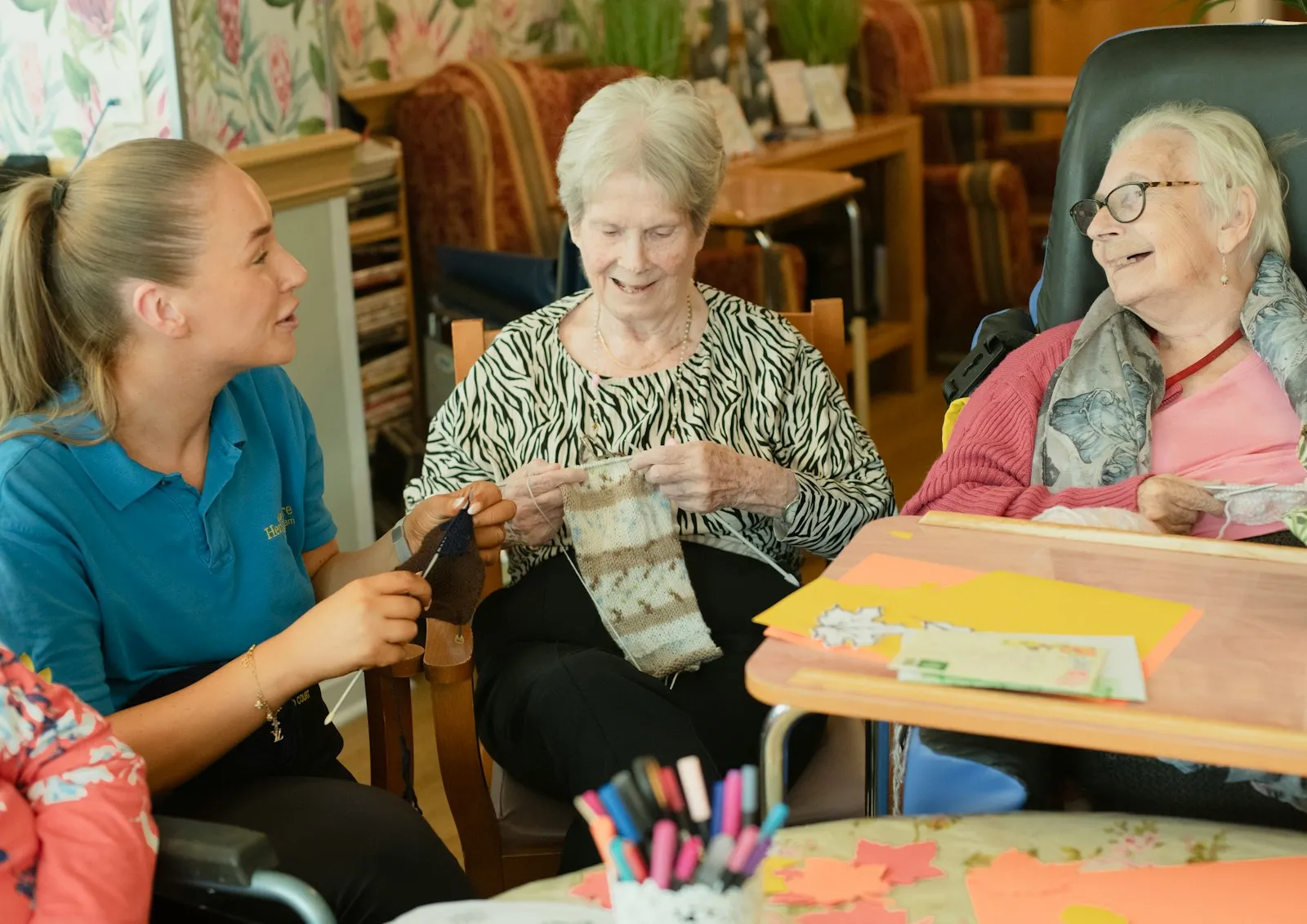
A care home provides 24/7 staff coverage with multiple people available (not just one carer), built-in social interaction with other residents, on-site activities, communal dining, and — in nursing homes — registered nurses for clinical interventions live-in carers can't deliver. But that infrastructure comes with 23.7% annual staff turnover (Skills for Care, 2025) — meaning roughly a quarter of a resident's care team rotates out every year — and the unfamiliarity of an institutional setting that some people, especially those with dementia, find permanently disorienting.
The genuine care home strengths
- Multi-staff coverage — multiple carers on shift simultaneously, with relief always available
- Registered nursing (in nursing homes) — clinical interventions, IV therapy, pressure-care wound management
- Social infrastructure — communal dining, group activities, peer contact that addresses the loneliness many older people experience
- Specialist dementia units — dedicated, secure environments designed for safe wandering, behavioural management
- Emergency response — equipment and trained staff for falls, choking, sudden deterioration
- Respite cover built in — family carers can take a break without arranging separate respite
The genuine care home weaknesses
- 23.7% staff turnover — a resident's care team changes substantially every year; continuity of relationship is structurally difficult
- Unfamiliar environment — particularly disorienting for dementia, where new surroundings can accelerate cognitive symptoms
- Loss of privacy — shared bathing facilities, shared dining, minimal individual control over routine
- Residents-per-carer ratios — typically 1:5 to 1:8 in residential, 1:6 to 1:10 in nursing; live-in delivers 1:1
- Top-up fees — many homes charge above the local authority "usual cost" rate, requiring family contribution above any LA contribution
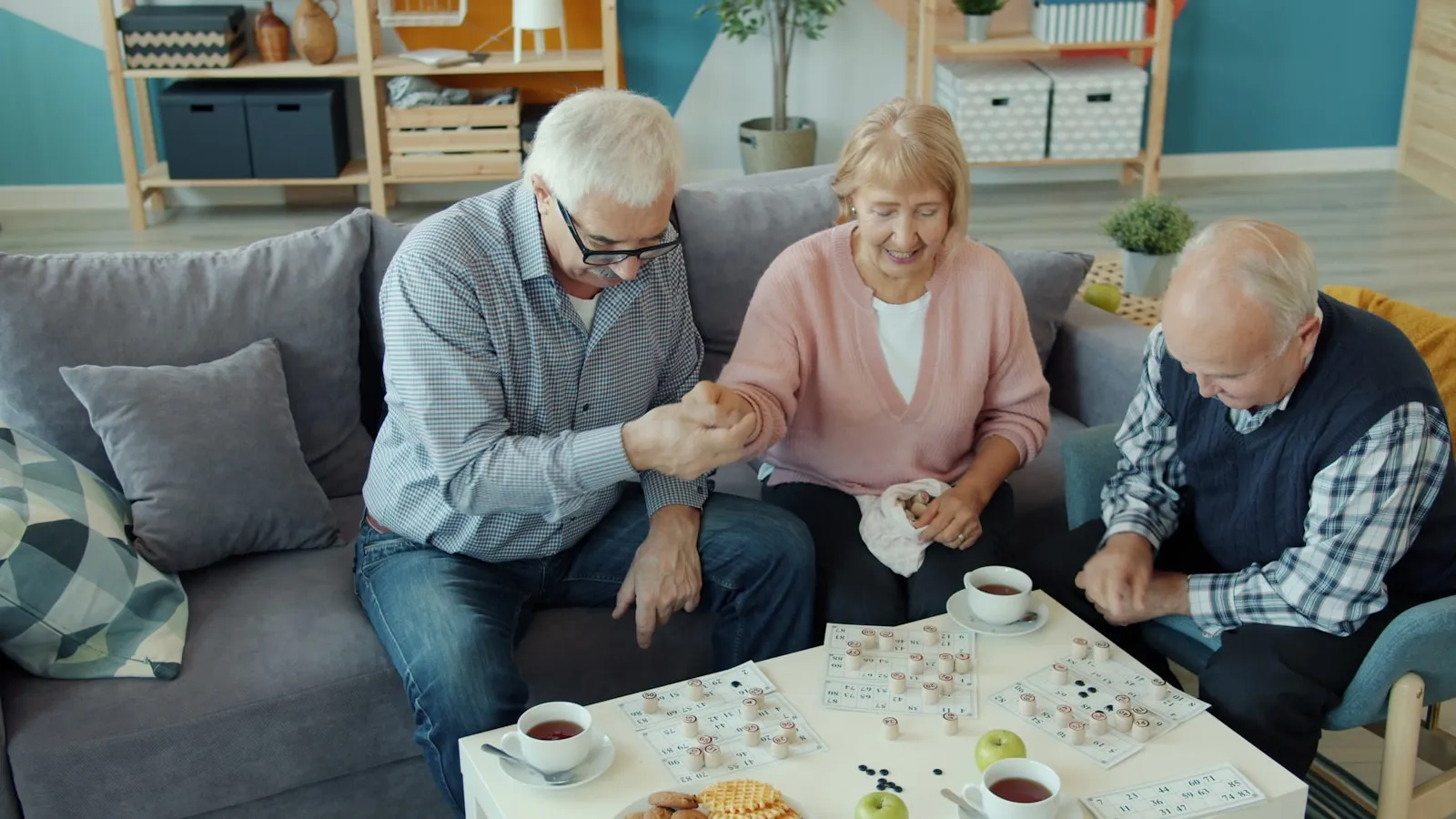
The 9 million older people in the UK reported to experience loneliness (Age UK, 2024) is often cited as the social-engagement argument for care homes. The honest read is more nuanced: care homes can provide built-in social contact, but many residents isolate within them regardless — particularly those with mobility limitations or hearing loss who can't easily join group activity. Live-in care addresses loneliness through the carer relationship and the preservation of existing community contacts (neighbours, family visits, local social networks) that a care-home move typically disrupts.
Live-in care vs care home — which is better for dementia?
For most dementia cases, live-in care is preferable in early-to-moderate stages (FAST 4-6) because of the continuity-of-carer evidence and familiarity-of-environment benefits — but care homes become preferable in advanced dementia (FAST 7+) when complex behavioural symptoms, exit-seeking, and night-time disorientation emerge that require multi-staff response and a secure environment (Alzheimer's Society, 2025). The decision isn't binary — it's a progression.
Where live-in care wins for dementia
- Continuity of carer relationships — the same 2-3 named carers attend over months and years, allowing the person to build familiarity even as cognition declines
- Familiar environment — the home, its layout, the spatial memory of where things are; moving someone with dementia is documented as accelerating decline
- Routine preservation — the morning cup of tea in the same chair, the same TV programme, the same garden view — small continuities that anchor the person
- No new faces every shift — institutional dementia care relies on staff who may or may not be familiar; live-in builds a single sustained relationship
- Reduced sundowning trigger — the agitation that often appears in late afternoon is frequently driven by unfamiliar surroundings, which live-in doesn't introduce
Where a care home wins for dementia
- Late-stage night-time symptoms — when the person is awake and active at 3am every night, a single live-in carer on a sleeping overnight break can't safely manage; care home night staff can
- Severe exit-seeking — secure dementia units have locked doors, alarms, and trained staff. A home rarely matches this
- Behavioural emergencies — sudden aggression, falls during wandering, choking incidents — a multi-staff team responds faster than one live-in carer can
- Family capacity exhaustion — when family support around the live-in arrangement breaks down, the structured institutional setting takes that weight off
- End-stage 24-hour active care — by FAST 7+, the person typically needs continuous active care that exceeds what one live-in carer can deliver
The progression model most families end up following
In practice, most families with a dementia trajectory follow a three-stage pattern: home with hourly domiciliary visits in the early stage (mild cognitive impairment to early dementia), live-in care in the middle stage (moderate dementia), and a care home in the late stage (severe dementia, complex needs). The mistake families make is treating it as a binary "now or later" decision rather than a continuum that adjusts as needs change. Live-in care is the most underused middle-stage option — most families skip it and move directly from hourly visits to a care home when needs intensify.
The 23.7% staff turnover figure matters most in this context. For someone with mild-to-moderate dementia, a stable relationship with the same carer over a year or two is one of the highest-evidenced quality factors. A care home structurally can't deliver that at scale. Live-in care can.
Can NHS Continuing Healthcare pay for live-in care?
Yes — NHS Continuing Healthcare can fully fund live-in care at home if the cared-for person meets the "primary health need" test under the National Framework for NHS Continuing Healthcare, on identical eligibility rules to CHC in a care home. Around 16.65% of standard CHC assessments end in eligibility (King's Fund, June 2026), while Fast Track CHC for rapidly deteriorating conditions accounts for the large majority of awards — 27,894 of the 30,379 people found eligible in Q3 2025/26 (NHS England, February 2026) — and most Fast Track packages can be delivered as live-in care when home is the right setting.
How CHC funds live-in care in practice
When CHC is awarded, the Integrated Care Board (ICB) commissions the care. Three operating models exist:
- ICB-commissioned live-in package — the ICB selects a CQC-regulated live-in provider from its approved list and arranges the care. Families typically have a "Choice of Provider" right and can nominate a preferred agency.
- Personal Health Budget (PHB) — the family receives the cash equivalent of the CHC package and arranges the live-in care themselves, with regular reporting back to the ICB. PHBs are now the default offer under the PHB guidance and are usually preferred for live-in because they preserve continuity with an existing trusted carer.
- Notional PHB — the ICB holds the budget but the family directs how it's spent. A middle ground between ICB control and a full cash PHB.
For couples, CHC eligibility is tested individually. If both partners qualify, the live-in arrangement can be fully NHS-funded covering both — though this is uncommon because both partners would need to meet the primary health need test in their own right. More commonly, one partner is CHC-eligible and the other is not — in which case the ICB funds the proportion of the live-in package attributable to the eligible partner.
The free CHC Eligibility Screener takes around 5 minutes and tells families whether a Checklist request is worth pursuing. For the full mechanics of the CHC application process, the NHS Continuing Healthcare pillar covers the Checklist → Decision Support Tool → eligibility decision pathway in detail.
How to choose between live-in care and a care home — decision framework
The decision typically rests on four factors: (1) cost — closer than most families realise for singles, materially different for couples; (2) care intensity — live-in scales to FAST 6-7 dementia, care homes are required beyond that; (3) social needs — care homes win for someone who craves daily peer contact; (4) continuity preference — live-in preserves home, familiar surroundings, and named-carer relationships at the cost of multi-staff coverage. The pre-decision question to ask is always CHC eligibility, because a successful award eliminates the cost calculation entirely.
When live-in care wins
- Couples — the £56,000-£72,000/year saving is hard to argue against
- Mild-to-moderate dementia — continuity-of-carer is the highest-evidenced quality factor at this stage
- Strong family network already in place — live-in supplements family rather than replacing it
- Property the person doesn't want to leave — both for memory reasons and inheritance reasons
- Existing community ties — neighbours, local church, GP relationship, hairdresser — all preserved
- Need for 1:1 attention — visual impairment, hearing loss, profound deafness, complex communication
When a care home wins
- Late-stage dementia (FAST 7+) — behavioural symptoms require multi-staff response
- Severe sundowning or night-time disorientation — needs continuous active care a live-in carer can't sustain
- Family far away with limited capacity for oversight — institutional setting takes the weight off
- Person actively wants peer contact — many older adults find communal dining and group activity genuinely valuable
- Property unsuitable — stairs, narrow doorways, dampness, isolation in rural area
- Complex clinical needs requiring registered nurses — IV therapy, complex wound care, ventilator support
The decision flowchart
The pre-decision question is the CHC question — because if NHS Continuing Healthcare funds either option fully, the cost dimension disappears and the choice becomes purely about quality of life. That's almost always a better way to make the decision than the cost-driven version, and it's why the framework starts with the CHC screener rather than with the cost comparison.
Verdict
For singles, live-in care and care homes are cost-comparable at around £1,300-£1,600 a week — the choice is best made on quality of life, dementia stage, and family capacity rather than headline price. For couples, live-in care is materially cheaper, by £56,000-£72,000 a year, and that gap is large enough that the financial argument typically dominates unless one partner has clinical needs that genuinely require a nursing home environment.
Key takeaways:
- Standard live-in care: £1,200-£1,500/week vs residential care home: £1,298/week (broadly equivalent for singles)
- Couples in live-in: £1,400/week vs two care home placements: £2,596/week (£62,000+/year saving)
- Staff continuity: live-in delivers 2-3 named carers; care homes have 23.7% annual staff turnover
- Dementia progression: live-in for early-to-moderate (FAST 4-6); care home for late-stage (FAST 7+)
- CHC equality: NHS Continuing Healthcare can fund either option fully if primary health need test is met
- Pre-decision question: check CHC eligibility first — a successful award removes the cost comparison entirely
If you're choosing between live-in care and a care home, the question to settle first is whether NHS Continuing Healthcare should be funding the care entirely — because if it should, the cost comparison disappears and the choice becomes purely about quality of life. Our free CHC Eligibility Screener takes around 5 minutes and tells you whether a Checklist request is worth pursuing. A successful CHC award can save families £60,000+ a year regardless of which delivery setting they choose, and it preserves the choice on non-financial grounds — which is the way most families wish they'd been able to make the decision from the start.
Frequently asked questions
Is live-in care cheaper than a care home?
For singles, the costs are similar — live-in care at £1,200-£1,500/week vs residential care at £1,298/week average. For couples, live-in is materially cheaper: one carer covers both at a single fee, vs two care home placements averaging £2,596/week combined — a £56,000-£72,000/year saving. Dementia-specific live-in often comes out cheaper than dementia care homes.
How much does live-in care cost for dementia?
Dementia-specific live-in care typically costs £1,400-£1,700/week in 2026, rising to £1,800+ for advanced needs. Specialist dementia care homes charge £1,500-£1,700/week. For early-to-moderate dementia, live-in is often cost-comparable and quality-superior thanks to carer continuity. For late-stage dementia (FAST 7+), care homes may be more appropriate.
Can a live-in carer be left alone with my relative overnight?
Yes — a single live-in carer provides 24-hour cover with an 8-hour overnight sleeping break mandated under the Working Time Regulations. If overnight needs are too high for one carer to manage, the package upgrades to two carers in rotation or to a 'waking nights' arrangement (£260+/night). Most live-in agencies risk-assess this before placement.
What happens when the live-in carer needs a break?
Standard live-in packages include a guaranteed 2-hour daily break and one full day off per week. A second rotation carer or family member covers during these periods. Most UK agencies use 2-carer rotations on 2-4 week shifts, so the cared-for person always has a familiar primary carer in residence.
Can NHS Continuing Healthcare pay for live-in care?
Yes — NHS CHC funds live-in care fully when the cared-for person has a 'primary health need' under the National Framework. The eligibility test is identical whether care is delivered at home or in a care home. Around 16.65% of standard CHC assessments end in eligibility (King's Fund, June 2026), while Fast Track CHC for rapidly deteriorating conditions accounts for the large majority of awards — 27,894 of 30,379 in Q3 2025/26 (NHS England, February 2026).