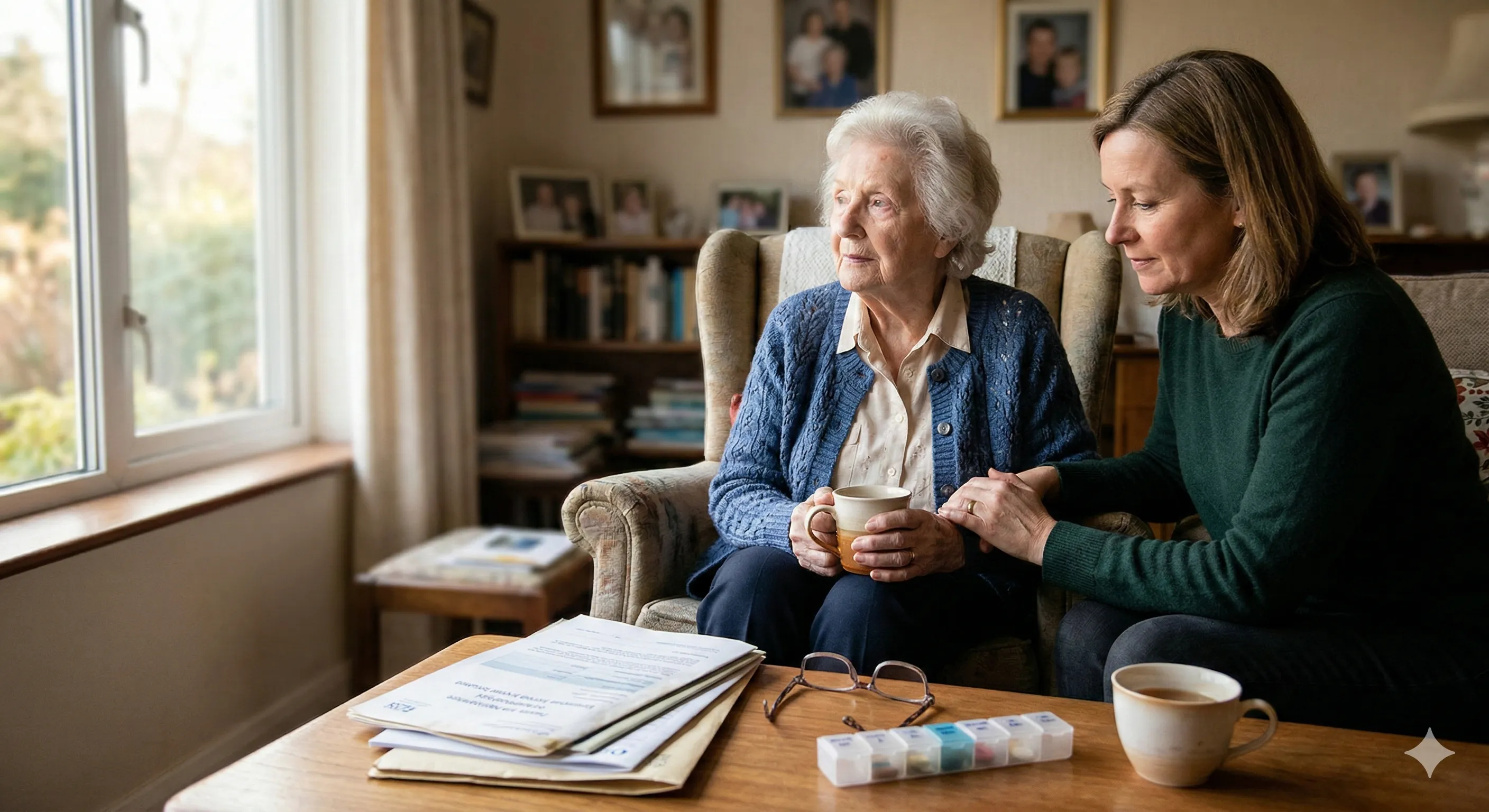
More than 80% of standard CHC assessments are refused — often because families don't know what they're up against. This guide reveals the seven most common mistakes that lead to rejection, and exactly how to avoid each one. Based on the NHS National Framework for CHC and FNC (2022).
1Will the NHS tell you about CHC funding?
The NHS has a legal duty to assess anyone who may have a primary health need, but in practice families are rarely told that CHC exists. Hospital discharge teams focus on arranging social care placements quickly, and many GPs are unfamiliar with the CHC process. If nobody mentions it, families start paying care home fees from day one — often tens of thousands of pounds before they discover they may have been eligible for fully-funded NHS care all along.
What to do instead: Do not wait to be told. If your relative has complex, ongoing health needs — particularly after a stroke, dementia diagnosis, or hospital stay — ask the ward sister, social worker, or GP to arrange a CHC Checklist screening. You can request one at any time, not just at hospital discharge.
Check eligibility now→2Should you accept a CHC Checklist refusal?
The CHC Checklist is a screening tool, not a full assessment. It only needs to indicate that a person "may be eligible" to trigger a full Decision Support Tool (DST) assessment. Despite this low threshold, many ICBs use the Checklist to filter people out. Families are told their relative "didn't score high enough" and accept this without question — but the Checklist was never designed to make a final eligibility decision.
What to do instead: If the Checklist result is negative, ask for the completed form and check whether your relative's needs were accurately recorded. You have the right to challenge the outcome and request that it be reconsidered. Many successful CHC claims began with a Checklist that was initially marked as negative.
3What evidence do you need before the DST meeting?
The DST assessment meeting is where the multi-disciplinary team (MDT) scores your relative across 12 care domains. Families often attend unprepared, relying on professionals to present the full picture. But clinicians at the meeting may not know your relative well, records may be incomplete, and the assessors only have the information in front of them. Without prepared evidence, needs are routinely under-scored.
What to do instead: Before the DST meeting, gather care home daily records, GP letters, hospital discharge summaries, incident logs, and medication charts. Write a family statement describing your relative's needs on their worst days, not their best. Map your evidence against each of the 12 care domains so nothing is missed.
Understand the 12 domains→4What is the “well-managed need” trap in CHC?
This is the single most common reason families lose CHC funding. The “well-managed need” argument says that because your relative's care is currently well-managed — perhaps by a skilled care home — their needs are not severe enough to qualify for CHC. This is a misapplication of the NHS National Framework (2022), which states clearly that “the decision should be based on what the person's needs are, and not on how well those needs are currently being managed.”
What to do instead: If an assessor describes your relative's needs as “well-managed,” challenge this directly. Ask: “What would happen if this care were removed?” The correct legal test is the nature, complexity, intensity, and unpredictability of the needs themselves — not whether a care home is currently managing them successfully.
5How do the 12 DST domains and scoring work?
The DST assesses needs across 12 domains, from behaviour and cognition to breathing and skin integrity. Each domain is scored from No Needs through to Priority. Many families focus on one or two domains where needs are obvious and neglect others. But CHC eligibility depends on the overall pattern of scores across all domains — a combination of High scores can qualify just as a single Severe can.
What to do instead: Study all 12 domains before the assessment. For each domain, prepare specific examples with dates, times, and outcomes. Even domains that seem less relevant — such as communication or altered states of consciousness — can contribute to the overall picture of a primary health need.
Learn all 12 domains→6Missing the appeal deadline
If your relative is found not eligible for CHC, you have the right to request a local review from the ICB. However, this must be done within six months of the decision being communicated to you. After the local review, if you remain unsuccessful, you can escalate to an Independent Review Panel (IRP) through NHS England. Missing these deadlines means losing the right to challenge — even if the original decision was clearly wrong.
What to do instead: Note the date you receive the decision letter and diarise the six-month deadline immediately. Submit your local review request in writing to the ICB, include new or additional evidence where possible, and keep copies of everything. If the local review is unsuccessful, request the IRP within the timeframe given in the ICB's decision letter.
How to appeal→7Going through the process alone
The CHC process is adversarial in practice, even though it is not supposed to be. ICB assessors conduct these meetings regularly and understand the framework inside out. Families, by contrast, encounter it once — usually during one of the most stressful periods of their lives. Without support, it is easy to feel intimidated, to accept scores without challenge, or to miss critical arguments that could change the outcome.
What to do instead: You do not need a solicitor — CHC advocacy is not a regulated legal activity — but having informed support makes a significant difference. At minimum, bring someone to the meeting who can take notes and ask questions. For professional support, consider an independent CHC advocate who understands the framework and can help you prepare and present your case.
Start with a free eligibility check→Frequently asked questions
What is NHS Continuing Healthcare (CHC)?
NHS Continuing Healthcare is a package of care that is fully funded by the NHS for people who have a "primary health need." Unlike social care, CHC is free at the point of use and is not means-tested — meaning your savings, property, and income are irrelevant. If eligible, all care costs are paid by the NHS, whether care is delivered in a care home, nursing home, or at home. Eligibility is determined by the nature, complexity, intensity, and unpredictability of the person's health needs, as assessed using the Decision Support Tool (DST).
How do I know if my relative might be eligible for CHC?
Your relative may be eligible if they have significant, ongoing health needs that require regular clinical intervention or skilled nursing care. Common indicators include advanced dementia with challenging behaviour, neurological conditions affecting multiple aspects of daily life, severe mobility problems with high falls risk, or conditions requiring ongoing clinical management such as PEG feeding, catheter care, or complex wound management. The first step is to request a CHC Checklist screening from your local Integrated Care Board (ICB) or during a hospital discharge.
Can I apply for CHC at any time, or only at hospital discharge?
You can request a CHC Checklist screening at any time — not just when your relative is being discharged from hospital. Many families mistakenly believe the opportunity has passed once someone is settled in a care home, but this is not the case. You can also request a retrospective review if your relative should have been assessed for CHC in the past but was not. If the review finds they should have been eligible, the NHS may be required to refund care fees paid during the period in question.
What is the “well-managed need” argument and why does it matter?
The “well-managed need” argument is used by some ICBs to downplay the severity of a person's needs. They argue that because the care home is managing the person well, their needs are not severe enough for CHC. However, the NHS National Framework (2022) explicitly states that eligibility should be based on what the needs are, not how well they are being managed at the time of the assessment. If this argument is used during your relative's assessment, you should challenge it by referencing paragraph 93 of the National Framework and asking the assessor to consider what would happen if the current level of care were withdrawn.
How long does the CHC process take from start to finish?
The NHS target is 28 days from the Checklist screening to a DST decision. In practice, the process frequently takes 2–3 months, and some ICBs take considerably longer. If your case exceeds the 28-day target, write to the ICB citing the NHS Framework target and requesting an update. If your relative's needs are urgent or they are approaching end of life, ask about the Fast Track pathway, which should be completed within 48 hours.
Not sure if your relative qualifies?
Our free screener takes 2 minutes and tells you whether a CHC application is worth pursuing.
Check eligibilityGet the free guide
Enter your email and we'll send the guide straight to your inbox. No spam, unsubscribe anytime.
Free. No spam. Unsubscribe anytime.
Sources: NHS National Framework (2022) | NHS.uk: Continuing Healthcare