Key Facts
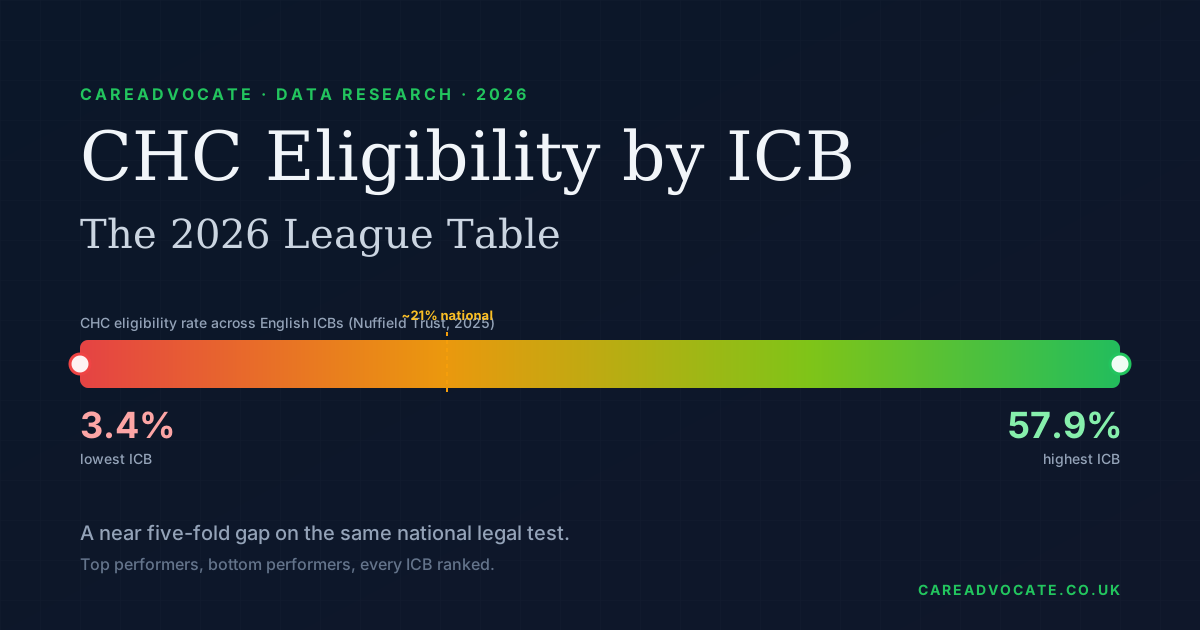
- 20 to 95 per 50,000 adults — range of adults eligible for NHS CHC between ICBs, an almost five-fold difference (as at 31 December 2024) (Nuffield Trust, September 2025)
- 10 to 67 per 50,000 adults — range for standard CHC specifically, a six-fold difference between the highest and lowest ICBs
- 5% to 32% — proportion of adults newly assessed as eligible for standard CHC, varying between ICBs (October–December 2024)
- £32,558 to £133,201 — crude average spend per eligible recipient for standard CHC, varying between ICBs (2022/23)
- One National Framework — the same legal test applies in every ICB; the variation comes from how it is applied
- 12 ICBs abolished, 6 new ICBs from 1 April 2026 — Phase 1 of NHS England merger programme
Every Integrated Care Board (ICB) in England applies the same National Framework for NHS Continuing Healthcare — yet the number of people found eligible varies almost five-fold from one ICB to the next. This article explains what that variation looks like, why it happens, and how a family can find and read their own ICB's published figures.
For the underlying argument about why this variation exists — and why it shouldn't — see our pillar on the CHC postcode lottery. To look up your own area by postcode, use the Find Your ICB tool.
TL;DR: The number of adults eligible for NHS CHC ranged from 20 to 95 per 50,000 adults between ICBs — an almost five-fold difference (Nuffield Trust, September 2025). The same National Framework applies everywhere, so the gap reflects inconsistent practice, not different rules. Rates vary; legal rights don't. Evidence quality is the lever every family can pull.
How CHC Eligibility Varies — The Headline Numbers
The number of adults eligible for NHS Continuing Healthcare ranged from 20 to 95 per 50,000 adults between ICBs as at 31 December 2024 — an almost five-fold difference between the highest and lowest ICBs (Nuffield Trust, September 2025). That is the single most important number in any conversation about CHC fairness.
It's worth being precise about which figure you're reading, because CHC comes in two routes. For standard CHC specifically, the range was 10 to 67 per 50,000 adults — a six-fold difference. For fast-track CHC (the route used when someone is approaching the end of life), it was 6 to 47 per 50,000. A separate measure looks at the flow rather than the stock: the proportion of adults newly assessed as eligible for standard CHC varied between ICBs from 5% to 32% in October to December 2024. Different cuts, same underlying problem.
The National Framework was written explicitly to produce uniform outcomes regardless of postcode. The figures show it does not. The Nuffield Trust does not publish a name-by-name ranking of ICBs, and this article does not either, because the policy point stands on the size of the gap rather than on a leaderboard.
Naming individual ICBs responsibly needs more than one quarter of data, which is why we publish the per-ICB figures separately and on a different basis: our CHC approval rates by ICB table ranks every ICB in England on a rolling 12-month rate, updated each quarter, with the methodology and its limits set out in full. Single quarters swing too far at ICB level to rank anyone fairly — four ICBs have moved more than 20 percentage points from one quarter to the next across the last three years of published data. What matters for a family is the scale of the variation and how to find their own area's figures, which we cover below.
What the Variation Looks Like in Practice
ICBs at the higher end of the range are not applying a more generous Framework — the Framework is national and identical everywhere. They are applying it more consistently. Areas with higher eligibility tend to share several features: experienced MDT panels with low turnover, Checklist thresholds that mirror the published guidance rather than a tighter local interpretation, and less appetite for borderline refusals that would otherwise require an immediate appeal anyway. The result is fewer marginal "no" decisions that bounce back as overturned refusals six months later.
In our own casework at CareAdvocate, ICBs at the higher end of the range tend to ask for less duplicate evidence at Checklist stage. Where a lower-eligibility assessor might request the same care home record three times in different formats, a higher-eligibility assessor reads it once and moves on. That's not a small difference — it shortens the assessment cycle by weeks for some families. The downstream effect on appeal volume is exactly what you would expect.
A high local eligibility rate doesn't guarantee an individual approval. It tells you what to expect, not what you will get. A well-prepared evidence pack still matters everywhere — it just clears the bar with less friction in a higher-eligibility area. The Find Your ICB lookup links through to per-area pages with local context and contact detail.
For families in a lower-eligibility area, the experience is meaningfully different. Refusal is a more common outcome at the Checklist stage. Dispute cycles are longer. Evidence requests are more aggressive. The emotional cost of pursuing CHC in a low-eligibility ICB is real and shouldn't be dismissed.
The critical thing to hold onto, though, is that legal rights under the National Framework are unchanged by geography. Lower-eligibility ICBs can and do overturn refusals at appeal. Appeal-outcome data isn't published at ICB level, but our own caseload shows that ICBs at the lower end of the eligibility range are not appreciably less likely to reverse a refusal once the evidence is presented properly.
Look up your area: NHS England publishes ICB-level CHC and FNC data every quarter as Management Information spreadsheets on its NHS CHC statistics page. You can download the latest file and find your own ICB. Our Find Your ICB tool will also point you to the right ICB by postcode.
Why Does Eligibility Vary So Much?
Three drivers explain most of the variation: local interpretation of the National Framework, MDT culture and assessor experience, and financial pressure on the ICB budget.
Local interpretation comes first because it's the most visible. The Framework's "primary health need" test asks whether someone's needs are beyond what a local authority can lawfully provide. Two assessors reading the same care home record can reach opposite conclusions if their local panel has settled on a tighter or looser threshold over time. Neither is openly defying the law. They are simply operating in different normative environments.
MDT culture follows. Panels with experienced, long-tenured chairs tend to produce more consistent decisions. Panels with high turnover and frequent locum involvement produce more variable ones. Training cadence matters too — ICBs that refresh assessor training regularly drift less from the published guidance than those that don't.
Budget pressure is the third driver, and it's the one that gets the policy attention. The variation reaches the money as well as the eligibility decision: the crude average spend per eligible recipient for standard CHC varied from £32,558 to £133,201 between ICBs in 2022/23 (Nuffield Trust, September 2025). Where ICBs face the largest savings targets, the temptation to narrow the eligibility interpretation is real, even when leadership formally denies it. The Staffordshire savings-plan controversy is the clearest documented example.
The honest summary is that this is a practice problem more than a pure resource problem. The same National Framework, the same legal test and the same guidance apply in every ICB. When eligibility still varies almost five-fold, the gap is being created by how that one rulebook is read and applied locally — not by the rulebook itself. That matters for families because practice can be challenged case by case: a refusal that reflects a local interpretation, rather than the Framework, is exactly the kind of decision an appeal exists to test.
How to Find — and Read — Your ICB's CHC Data
Most families don't know which ICB they fall under — and it is not the same as your local council. Use our Find Your ICB by postcode tool, or the official NHS ICB finder for the primary source. Both will return your ICB's name.
Once you know your ICB, you can look up its CHC figures directly. NHS England publishes ICB-level CHC and FNC data every quarter as Management Information spreadsheets (XLSX) on its NHS CHC statistics page. Download the most recent file, find your ICB's row, and you can see how many people it has on standard and fast-track CHC. Comparing that against neighbouring ICBs gives you a realistic sense of where your area sits — without relying on anyone's interpretation of the numbers.
A note of caution when reading these spreadsheets: a single quarter can move for reasons that have nothing to do with practice — a backlog being cleared, a reporting correction, or seasonal end-of-life referrals. Look at the trend across several quarters rather than one figure, and compare population-adjusted measures (per 50,000 adults) rather than raw counts, since ICBs differ enormously in size.
ICB vs Local Authority — quick reference
Your local authority handles means-tested social care under the Care Act 2014. Your ICB handles NHS Continuing Healthcare under the National Framework. The two systems sit alongside each other and sometimes argue over which side of the line a particular care need falls on. When CHC is refused, families often find their council taking over with a financial assessment — and that's where the difference matters most. CHC is free at point of use; council-funded care is means-tested.
What if you move ICBs mid-assessment? Your case continues uninterrupted under the new ICB code. The April 2026 mergers re-assigned twelve ICBs into six new ones, and live cases were ported automatically. For families with an open Checklist or DST in one of the affected areas, see our guide to the April 2026 ICB mergers.
Does a Low Eligibility Rate Mean I Shouldn't Apply?
No. A low local eligibility rate does not change your legal rights under the National Framework. Lower-eligibility ICBs can and do overturn refusals at appeal — and evidence quality is the single biggest predictor of outcome, regardless of where you live.
There's a sharp version of this question that families ask honestly: if my ICB seems to turn most people down, am I throwing my time away? It's a fair question. The answer is that a headline rate is an average over all comers — strong cases and weak ones, well-prepared evidence and thin paperwork alike. It is not the rate you personally face. ICBs turn down many applications that arrive with thin or unstructured evidence. They turn down far fewer that arrive with a properly structured evidence pack mapped to the DST domains.
That's the framing shift that matters. Geography is not the variable you can change; evidence is. A Case Strength Report turns the question from "do I live somewhere CHC happens?" into "is this case strong enough to pursue?" — and that's a question with a defensible answer regardless of postcode.
Not sure if your case is worth pursuing? The Case Strength Report tells you in 48 hours, independent of your ICB's headline rate. Free initial review.
How Will the April 2026 ICB Mergers Affect CHC Eligibility?
On 1 April 2026, twelve ICBs were abolished and six new ones replaced them under Phase 1 of NHS England's merger programme (NHS England, April 2026). Where a lower-eligibility ICB has merged with a higher-eligibility one, the combined area's published figures will be re-baselined under the new geography — even though the underlying practice differences don't vanish overnight.
The published statistical series will need to be recompiled under the new ICB codes, and that takes time to settle. For families with live cases, nothing operationally changes: the case ID stays the same, the assessor team transitions across, and the decision letter comes from the successor ICB.
What's worth watching is whether the re-baselining masks previous variation. If a lower-eligibility ICB merges with a higher-eligibility one, the combined figure will sit somewhere in the middle — useful for headlines, less useful for the people in the part of the new footprint that still faces the same local practice culture. The Find Your ICB lookup will be updated to reflect successor geographies as the first post-merger quarter publishes.
Frequently Asked Questions
How much does CHC eligibility vary between ICBs?
The number of adults eligible for NHS CHC ranged from 20 to 95 per 50,000 adults between Integrated Care Boards as at 31 December 2024 — an almost five-fold difference between the highest and lowest ICBs (Nuffield Trust, September 2025). For standard CHC specifically, the range was 10 to 67 per 50,000 — a six-fold difference.
Where can I find my own ICB's CHC figures?
NHS England publishes ICB-level CHC and FNC data every quarter as Management Information spreadsheets on its NHS CHC statistics page. Download the latest file, find your ICB's row, and you can see how it compares with others. Use our Find Your ICB tool first if you are not sure which ICB covers your postcode.
Why does CHC eligibility vary so much between ICBs?
Every ICB applies the same National Framework, but it is applied inconsistently. The main drivers are differences in how local panels interpret the "primary health need" test, MDT culture and assessor experience, and budget pressure on the ICB. It is largely a practice problem, not a difference in the rules.
Is it harder to get CHC funding in some areas?
In raw eligibility terms there is a real, almost five-fold gap between the highest and lowest ICBs. But your legal rights under the National Framework do not change with geography. Lower-eligibility ICBs can and do overturn refusals at appeal when the evidence is well-prepared and properly mapped to the DST domains.
Has my ICB changed since April 2026?
Twelve ICBs were abolished on 1 April 2026 and six new ICBs replaced them under Phase 1 of NHS England's merger programme. If you live in one of the affected areas, your CHC case continues uninterrupted under the new ICB — see our guide to the April 2026 ICB mergers.
Where the Data Comes From
The variation figures in this article come from the Nuffield Trust's All or Nothing: access and variation in NHS Continuing Healthcare, published September 2025, which analyses NHS England's published CHC data. NHS England itself publishes ICB-level CHC and FNC data every quarter as Management Information spreadsheets on its NHS CHC statistics page — the primary source families can use to look up their own area.
Every figure quoted here carries a date-of-record. The 20-to-95-per-50,000 range (all CHC) and the 10-to-67-per-50,000 range (standard CHC) are as at 31 December 2024. The 5%-to-32% newly-assessed-eligible range covers October to December 2024. The £32,558-to-£133,201 spend-per-recipient range is for 2022/23. We don't conflate these — they are different cuts of the same problem.
Closing Thought
Eligibility varies dramatically between ICBs. Legal rights do not. Evidence quality is the lever every family can pull — and it's the one that matters most, regardless of which ICB stamps the decision. An almost five-fold gap is not natural variation in a system designed to produce uniform outcomes; it is the consequence of inconsistent practice that the National Framework was supposed to eliminate. Until the practice gap closes, the families who do best are the ones who prepare best.
Start by finding out where you stand — both geographically and evidentially. The Find Your ICB lookup points you to your area, and NHS England's quarterly statistics let you read its figures for yourself. A Case Strength Report tells you whether your specific case is worth pursuing, independent of any headline rate. Together they answer the only two questions that matter at the start of a CHC journey: what's the lay of the land, and is my case strong enough to walk it?
This article was reviewed by legal professionals and social care professionals at CareAdvocate.