Key Facts
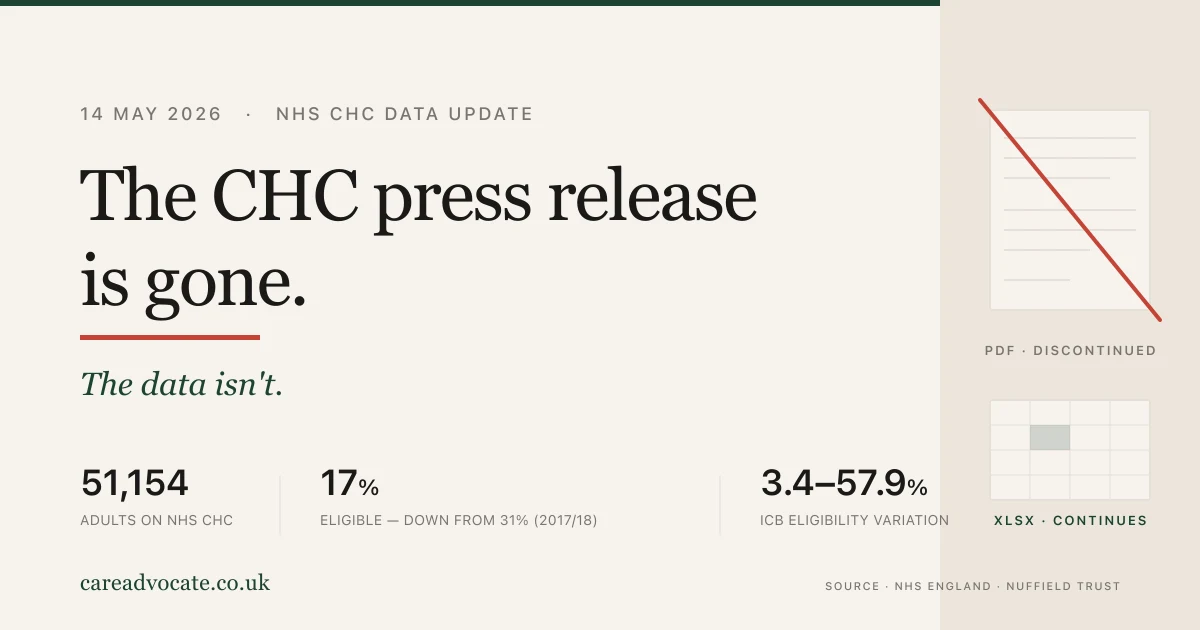
- 14 May 2026 — NHS England discontinued the quarterly CHC Statistical Release & Report PDFs (NHS England, May 2026)
- CHC data continues on the same page as quarterly Management Information XLSX — the most recent file is Q4 2025/26
- The last formal press release covered Q3 2025/26 — 51,154 adults eligible at a 17% rate (NHS Digital, February 2026)
- The All Age Continuing Care (AACC) data set is a parallel development — not yet the statistical home for adult CHC
- No NHS-authored commentary, summary visuals or press release accompanies the new XLSX files
- Postcode-lottery variation across ICBs — 20 to 95 eligible per 50,000 adults, an almost five-fold difference — remains measurable in the data (Nuffield Trust, September 2025)
The last NHS Continuing Healthcare press release was published quietly. No headline. No explainer. Just a paragraph on the existing statistics page noting that, from 14 May 2026, the PDF format has been discontinued. Families who relied on the quarterly headline figure now have to read it themselves — in a raw spreadsheet, with no commentary alongside. This post is the news story: what actually changed, and why. For the practical companion guide — where the figures live now and how to read them — see how to find and read NHS CHC statistics.
TL;DR: On 14 May 2026, NHS England discontinued the quarterly CHC Statistical Release and Report PDFs (NHS England, May 2026). The data itself still publishes — as raw XLSX on the same page — but the NHS-authored commentary, headline summary and press release that helped families interpret it are gone. The often-cited All Age Continuing Care data set is still under development; it has not yet replaced the existing CHC and FNC quarterly Management Information series.
What Actually Changed on 14 May 2026?
From 14 May 2026, NHS England discontinued the CHC Statistical Release and Report PDFs; CHC data continues on the same page as quarterly Management Information XLSX (NHS England, May 2026). The shift isn't a decision to stop measuring CHC. It's a decision to stop narrating it.
The last document in the old format was the Q3 2025/26 statistical release, published 12 February 2026 by NHS Digital. It showed 51,154 adults eligible for NHS CHC at a national rate of 17% — figures that would have come with a press release and an explanatory commentary in any prior quarter. The next quarter — Q4 2025/26, published in May — appeared as a 238KB XLSX file with no accompanying narrative. Same page. Same raw numbers. No story.
What didn't change
The dataset itself is in the same place. CHC and FNC quarterly data continues to publish through the existing NHS England statistics page, with the most recent file labelled "CHC and FNC – Quarterly Data Q4 2025-26". Sub-ICB-level breakdowns, eligibility rates, 28-day completion figures, fast-track activity — all still there.
What the AACC data set actually is
A separate development worth understanding. The All Age Continuing Care (AACC) data set was launched as a data collection on 1 April 2025, and aims to eventually unify adult CHC, NHS-funded nursing care, joint-funded packages and children's continuing care into a single all-age data architecture (NHS England Digital, 2025). The v2.0 standard is still under development; it isn't yet the statistical reporting home for adult CHC. Conflating "PDF discontinued" with "moved to AACC" misreads what actually happened on 14 May.
What's Still Visible — and What's Now Hidden?
The numbers survive; the narrative does not. Every headline metric that mattered to advocates and journalists in the old format still publishes in the quarterly XLSX — but the commentary, contextualisation and accessible summary visualisations that helped families interpret those numbers have gone with the press release.
What's preserved
- National totals — number of adults eligible for NHS CHC, broken down by standard CHC and fast-track
- Eligibility rates — overall and by route
- ICB-level breakdowns — sub-ICB locations included
- Referral activity — new referrals, referrals completed, referrals completed within 28 days
- Assessment activity — DSTs completed in acute and non-acute settings
- NHS-funded Nursing Care activity — alongside CHC, as before
What's lost
- The NHS-authored commentary — every quarter for the past decade, NHS Digital published a short interpretation of the figures. That's gone.
- The headline press release — the artefact journalists and advocacy groups quoted. Gone.
- Pre-built summary visualisations — the charts that turned raw figures into accessible insight. Gone.
- A single, family-readable landing page — the old PDF was one document. The new format is multiple files across multiple landing pages.
Did NHS England announce the change loudly? No. The discontinuation notice sits as a paragraph on the existing statistics page. If you've used the old release format and bookmarked the URL, you'll still land somewhere useful — but the document you came for no longer exists.
Will the AACC Data Set Eventually Fix This?
The AACC data set is designed to plug a longstanding gap in CHC reporting — though it isn't there yet (NHS England Digital, 2025). Worth understanding what's planned, because some of the coverage around the 14 May change conflates the AACC roadmap with what actually landed this month.
The current data architecture has a structural hole. Adult NHS CHC and NHS-funded nursing care have their own quarterly publication. Joint-funded packages of health and social care — common in complex cases — aren't separately reported. Children and young people's continuing care, governed by a different national framework, sits outside the dataset entirely. Parents and carers of children with complex needs face eligibility battles that mirror those of adults, but with no comparable national figures to cite.
The AACC v2.0 data set is designed to close that gap: adults, children, joint packages, all collected to a single standard. For an advocacy charity analysing where regional inconsistency hits hardest, that would be the single biggest data improvement in CHC reporting in a decade. But the standard isn't yet mandated. ICBs haven't fully implemented it. And — most importantly for the May 2026 change — adult CHC statistics still publish through the existing CHC and FNC series, not AACC. The promise is real. The delivery is still in progress.
How to Find Your ICB's CHC Eligibility Rate Now
The page hasn't moved, only its summary has. Start at the NHS England CHC statistics page, scroll to the most recent quarter (currently Q4 2025/26), and download the XLSX file. Filter the rows by sub-ICB code. The eligibility rate sits as a single column.
In our own walkthrough this week, the click-path took five steps and about three minutes — once you know what you're looking for. The first time it took twenty. Most families won't do this themselves. They shouldn't have to. But the steps are:
- Land on the NHS England CHC statistics page
- Scroll past the discontinuation notice to the data files
- Download the XLSX for the most recent quarter (Q4 2025/26 at time of writing)
- Open it and filter by your sub-ICB code
- Read the eligibility rate and 28-day completion columns
Two complications worth flagging. First, the ICB codes changed on 1 April 2026 — twelve ICBs were abolished and six new ones formed, so historical breakdowns by old ICB don't align with current geography (see our guide to the April 2026 ICB mergers). Second, the figures are now released without the previous NHS-authored commentary that would flag unusual quarter-on-quarter movements. The numbers haven't changed format; the interpretation that used to sit beside them has gone.
Does Less Transparency Mean More Postcode Lottery?
The risk isn't the absence of data — it's the absence of accessible commentary. The postcode lottery the old releases helped expose is still measurable in the new XLSX files. Nuffield Trust analysis from September 2025 documented an almost five-fold variation in CHC eligibility across English ICBs — the number of adults found eligible ranged from 20 to 95 per 50,000 adults (as at 31 December 2024) (Nuffield Trust, September 2025). That work was only possible because the underlying data was already public. The new format doesn't change that. It does change how easy it is to spot the next one.
Third-party analysis has always done the heavy lifting on CHC variation. Nuffield Trust, Age UK, Care England, the Care Quality Commission — they read the raw figures and produce the public commentary. NHS England's press release simply gave them a peg. Take away the peg and you still have the analysis. You just lose the small advocacy organisations who don't have analyst capacity to read an XLSX.
There's a knock-on effect that's easy to miss. The postcode lottery becomes invisible to families whose ICB sits at the wrong end of the curve. Without a published headline figure, a refusal letter in a low-eligibility ICB looks exactly like a refusal letter in a high-eligibility one — even though the number of adults found eligible can differ almost five-fold between them. The data difference is the same. The visibility of that difference is what's degraded. We've written before about how postcode-lottery variation actually plays out in practice — that piece holds the longer argument.
What Families Should Do Differently Now
Three things. Bookmark the new home, save a copy of the last formal release, and cite the published figures whenever you escalate.
First, bookmark the NHS England CHC statistics landing page. It's the same URL you'd have used before; the quarterly XLSX files now sit there without a press release alongside them. You'll come back to it.
Second, download and save the last formal NHS Digital release — Q3 2025/26, published 12 February 2026. It's the most comparable historical baseline you'll have. Format migrations have a habit of breaking old URLs over time; save it locally now.
Third, when you write to your ICB to dispute a refusal or chase a delayed assessment, reference the published figures explicitly. National eligibility at 17%, your ICB's published rate, the 76% within-28-days target — they all sit in the public record. Citing them shifts an ICB's reply from "we have applied the National Framework" to "we have applied the National Framework in a way that diverges from the published mean by X". That's a stronger negotiating position.
If you'd rather not download spreadsheets, the Beacon CHC free 90-minute advice line — NHS England's funded service — can help with procedural orientation. For an evidence opinion on whether your case is worth pursuing, our Case Strength Report takes the medical record review off your hands.
Citation Capsule — The 14 May 2026 change: On 14 May 2026, NHS England discontinued the CHC Statistical Release and Report PDFs. The official notice reads: "From 14th May 2026 the CHC Statistical Release and Report (PDFs) have been discontinued. All existing CHC data artefacts continue to be published quarterly as Management Information" (NHS England, May 2026). The last formal release covered Q3 2025/26 and showed 51,154 adults eligible at a 17% national rate (NHS Digital, February 2026).
Citation Capsule — What survives the format change: The headline CHC figures families and advocates have relied on — national totals, eligibility rates, sub-ICB breakdowns, 28-day referral completion — all continue to publish as quarterly Management Information XLSX on the same NHS England page. What's lost is the NHS-authored quarterly commentary, the press release, and the pre-built summary visualisations. The All Age Continuing Care (AACC) data set, often referenced in coverage of this change, is a separate development still under v2.0 standard work and is not yet the statistical home for adult CHC.
The format change itself doesn't affect any family's legal rights under the National Framework. It doesn't change the 17% eligibility rate. It doesn't change the five-fold regional variation. What changes is the friction between a family and the data that supports their case. That friction is now meaningfully higher.
Two things worth watching over the next few quarters. First, whether NHS England eventually publishes any commentary alongside the raw Management Information files — or whether the silence becomes permanent. Second, whether the AACC v2.0 standard becomes mandated, and if so, how its eventual statistical publications handle adult CHC alongside children's continuing care. Both matter for any appeal that relies on trend evidence. For a deeper sense of why ICB-level data is the single most useful piece of evidence in a low-eligibility area, our breakdown of the CHC postcode lottery walks through three live case patterns.
This article was written within five days of the 14 May 2026 transition. It draws on the NHS England CHC statistics landing page (as updated May 2026), the NHS Digital All Age Continuing Care data set documentation, the final NHS Digital Q3 2025/26 statistical publication (12 February 2026), and the Nuffield Trust's "Consigned to the Too Difficult Box" analysis (September 2025). It does not constitute legal advice. Content has been reviewed by legal professionals and social care professionals.
Frequently asked questions
Where are NHS CHC statistics published now?
CHC statistics continue to publish on the same NHS England statistics page they always have. The change on 14 May 2026 is that the quarterly Statistical Release and Report PDFs have been discontinued — the data continues quarterly as Management Information XLSX files. The page still shows the most recent quarter (Q4 2025/26 at time of writing), but without an NHS-authored press release or summary commentary alongside the figures.
Did NHS England stop publishing CHC data?
No. NHS England discontinued the PDF press release and report format, not the data itself. CHC numbers continue to publish quarterly as Management Information XLSX on the same page. Families and advocates can still find national totals, ICB-level breakdowns, eligibility rates, and 28-day completion figures — they just no longer come with a press-friendly summary or commentary.
Where is the last formal CHC press release?
The final NHS CHC Statistical Release in the old format covered Q3 2025/26 and was published on 12 February 2026 by NHS Digital. It showed 51,154 adults eligible for NHS CHC at a 17% national eligibility rate. That report remains accessible on the NHS Digital archive and is the last document with NHS-authored commentary — worth saving for any future appeal that needs a comparable historical baseline.
What about the All Age Continuing Care (AACC) data set?
AACC is a parallel NHS data collection launched on 1 April 2025 that is intended to eventually bring adult CHC, NHS-funded nursing care, joint-funded packages, and children's continuing care into a single all-age data architecture. As of May 2026, AACC is still under development — the v2.0 standard is not yet mandated, and adult CHC statistics continue to publish through the existing CHC and FNC quarterly Management Information series, not AACC.