Key Facts
- A retrospective CHC claim — formally a Previously Unassessed Period of Care (PUPoC) review — asks the NHS to assess a past period of care and refund the fees if the person had a primary health need
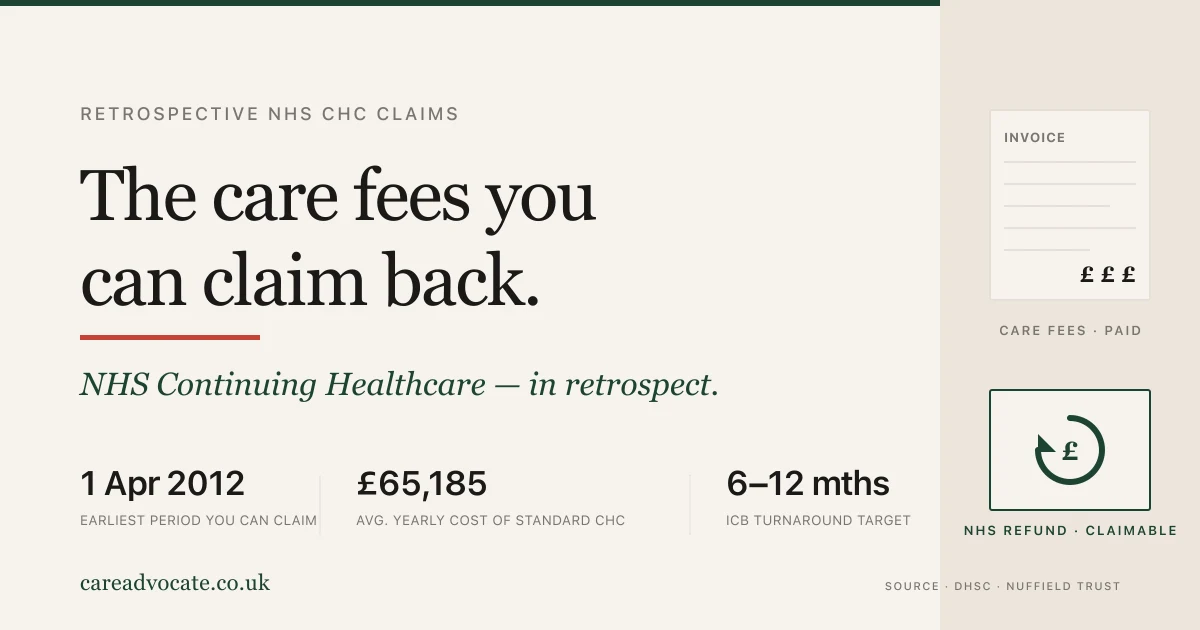
- Claims can generally only cover care from 1 April 2012 onwards — earlier periods were closed by deadlines in 2012 and 2013
- Families, attorneys, court-appointed deputies and the executor of an estate can all claim — many claims are made after the person has died
- Average standard CHC care now costs £65,185 a year (Nuffield Trust, 2025) — a multi-year refund can run to five or six figures
- A retrospective claim is won on the historic care records — and you do not need a no-win-no-fee solicitor to make one
Every year, thousands of UK families pay for care that the NHS should have funded — and most never find out. Only about 17 in every 100 people who reach a full NHS Continuing Healthcare assessment are now found eligible, down from 31 in 2017/18 (Healthwatch England, October 2025). But a far quieter problem sits behind that figure: people who were never assessed at all, who simply paid the care home invoice because no one told them NHS funding existed.
If that describes your relative, the money is not necessarily gone. A retrospective CHC claim asks an Integrated Care Board to look again at a past period of care and decide whether it should have been NHS-funded. This guide covers what a retrospective claim is, how far back it can go, who can bring one, how much is at stake, the process and the evidence — and the honest answer to whether you need a solicitor. A retrospective claim runs alongside the NHS CHC pathway as a separate route for care you've already paid for.
Reviewed by legal professionals and social care professionals.
What Is a Retrospective CHC Claim?
A retrospective CHC claim asks an ICB to assess a past period of care for NHS Continuing Healthcare eligibility — and, where the person is found to have had a primary health need, to refund the care fees they paid. The NHS term for it is a Previously Unassessed Period of Care, or PUPoC.
The word that matters is "unassessed". A retrospective claim applies where no CHC Checklist and no full Decision Support Tool assessment were ever carried out for that period. The person moved into care, the fees were paid, and the question of NHS funding was never properly asked. That happens far more often than it should — through hospital discharges that skip the screening step, through care homes arranged in a hurry, through families who were never told CHC existed.
This is a long-standing, recognised failure, not a fringe case. A 2003 Ombudsman report into wrongly self-funded care led the Department of Health to repay around £180 million to affected people (Parliamentary and Health Service Ombudsman, 2020). The retrospective route exists precisely because the system has always missed people.
A retrospective claim isn't the same as an appeal. An appeal challenges a recent CHC decision you disagree with. A retrospective claim assesses a period that was never decided either way. The legal test is identical, though — whether the person had a primary health need — and it is judged against the National Framework for NHS Continuing Healthcare as it stood at the time.
How Far Back Can a Retrospective CHC Claim Go?
ICBs will generally only assess periods of care from 1 April 2012 onwards. Care provided before that date was dealt with through historic "close-down" exercises with fixed deadlines that have now passed (GOV.UK guidance on previously unassessed periods of care). This is the single most misunderstood point in the whole subject.
Here is the part the no-win-no-fee adverts rarely explain. There is no rolling six-year window. The claimable period isn't "the last six years" — it's a fixed start date. The history runs like this:
- A close-down exercise in November 2007 ended claims for care provided before 1 April 2004.
- Care provided between 1 April 2004 and 31 March 2011 had to be claimed by 30 September 2012.
- Care provided between 1 April 2011 and 31 March 2012 had to be claimed by 31 March 2013.
Those deadlines have passed. What remains — and what you can still claim today — is care from 1 April 2012 to the present.
One practical limit sits inside that window. A retrospective claim depends on the clinical records still existing. Care homes and NHS bodies keep records for limited periods, so the further back a claim reaches, the harder the evidence becomes to find. A claim for 2013 is legally allowed — but only worth pursuing if the daily notes and medication charts from 2013 can still be obtained.
Who Can Make a Retrospective Claim?
A retrospective claim can be made by the person who received the care, by a family member acting for them, by an attorney under a Lasting Power of Attorney, by a court-appointed deputy, or — where the person has died — by the executor or administrator of their estate. You do not have to be the person who paid the fees.
That last point matters, because the reality of retrospective claims is a difficult one. Many are made after a bereavement. A parent dies, probate begins, and an adult child going through the paperwork realises how much was spent on a care home — and starts to wonder whether the NHS should have paid. That is a legitimate, common, and entirely valid reason to claim.
When the person has died, any refund is paid into their estate and then distributed under their will or the rules of intestacy. To act, you need legal authority — usually a grant of probate or letters of administration. If the person is still living but lacks the capacity to manage the claim themselves, an attorney under a registered Lasting Power of Attorney, or a court-appointed deputy, can act for them.
What if several family members are involved and don't agree? The claim belongs to the person or the estate, not to whoever feels strongest about it. In practice, one person leads — usually the executor or the named attorney — and keeps the others informed. Disputes between beneficiaries are a separate matter from the claim itself.
How Much Could You Reclaim?
There is no published "average" refund, but the scale is set by what care costs. Average standard CHC care cost £65,185 a year in the most recent analysis (Nuffield Trust, 2025), and self-funded nursing-home fees average around £1,535 a week — close to £80,000 a year (carehome.co.uk, 2026). A successful claim covering several years can therefore reach well into five, and sometimes six, figures — and it is normally repaid with interest, calculated as compound RPI since 2015, not the 8% many adverts imply.
A refund covers the care element of the fees actually paid — not always every invoice, since some accommodation or "hotel" costs can fall outside what the NHS funds. Treat any firm that quotes a confident "typical refund" with caution: the honest answer depends entirely on the length of the period and the strength of the records.
We've broken the full sum down in a dedicated guide — how to total the fees, and exactly how the NHS works out the interest (compound RPI, year by year): see the PUPoC money math, step by step. To scope your own situation quickly, our retrospective claim calculator estimates the period and the sum at stake. For wider context on care costs, see our guides on who pays for a care home and care home costs by region.
The Retrospective Claim Process, Step by Step
A retrospective claim runs through five stages: request the review in writing, gather the historic care records, the ICB builds a picture of the person's needs, a multidisciplinary team assesses that picture against the 12 care domains, and the ICB issues a written decision. The family's real job sits in stage two — making the evidence as complete as possible before anyone assesses it.
Here is how the process works in practice:
- Request the review in writing. Write to the ICB responsible for the area where the care was funded, asking for a retrospective CHC assessment (a PUPoC review) for a specific, dated period. Be precise about the dates and the care setting.
- Gather the care records. Obtain the contemporaneous records for the period — care home daily notes, medication charts, GP and district nurse records, hospital discharge summaries, and the care contract and invoices. This is the work that decides the claim.
- The ICB builds a "needs portrayal". Using the records, the ICB constructs a chronological picture of the person's health needs across the period — what their day-to-day care actually involved.
- A multidisciplinary team assesses it. A team reviews that picture against the 12 care domains and the Decision Support Tool, and against the primary health need test, as if the assessment had been done at the time.
- The ICB issues a written decision. You receive a written outcome — eligible or not eligible — with a refund and interest if the claim is upheld, and appeal rights if it is not.
The order is deliberate. An ICB will assess whatever evidence is in front of it, and a thin file produces a thin decision. A claim doesn't fail because the person wasn't eligible; it fails because the records that would have proved eligibility were never collected or never read.
What Evidence Wins a Retrospective Claim?
A retrospective claim is decided almost entirely on the contemporaneous records — the notes written at the time, not anyone's memory of it. The Ombudsman, reviewing CHC complaints, specifically identified "mistakes when undertaking reviews of previously unassessed periods of care" as a recurring failure (Parliamentary and Health Service Ombudsman, 2020). Weak evidence is what those mistakes feed on.
In our evidence-preparation work, the same documents decide retrospective claims again and again. Gather these, roughly in this order:
- Care home daily records — the day-to-day notes describing how the person was that shift: behaviour, mobility, falls, distress, refusals of food.
- Medication administration (MAR) charts — what was prescribed and given, including PRN ("as required") doses, sedation and pain relief.
- GP and district nurse records — visits, wound care, deterioration, referrals.
- Hospital records and discharge summaries — admissions, diagnoses, and the clinical picture at the point the person moved into care.
- The care contract and invoices — proof of who paid, how much, and for what period.
You get most of these by making a Subject Access Request under data protection law to the care home, the GP practice and the relevant NHS trust. Our guide to NHS Subject Access Requests walks through exactly how. If records are missing or have been destroyed, the claim is not automatically lost — but it becomes harder, and that is the strongest argument for not delaying.
One trap to watch for. ICBs sometimes argue a need was "well managed" and therefore not severe. The framework says the opposite: a need doesn't shrink because skilled care is controlling it. Our guide to the well-managed needs principle explains how to answer that argument. Understanding what evidence matters is the educational part — turning a box of records into a domain-by-domain case is the specialist work.
How Long Does a Retrospective Claim Take?
Government guidance sets best-practice targets: a period of care of a year or less should be completed within 6 months, and a longer period within 12 months, except in exceptional circumstances (GOV.UK guidance on previously unassessed periods of care). Those are the targets. The reality is often slower.
How far past those targets do ICBs run? No central figure for the national retrospective-claims backlog is published — and it is worth being straight about that, because anyone who quotes you a precise national waiting time is guessing. What is documented is the pattern of delay and error: the Ombudsman reached decisions on 336 CHC complaints between April 2018 and July 2020, with retrospective reviews flagged among the recurring problems (Parliamentary and Health Service Ombudsman, 2020).
The practical takeaway is to treat the 6- and 12-month figures as a standard you are entitled to hold the ICB to. Put your request in writing, keep a dated record of every contact, and if the ICB drifts well past its own target, say so in writing and ask for a timetable. Politeness and a paper trail are not in tension.
Do You Need a No-Win-No-Fee Solicitor?
No — a retrospective claim can be made directly to the ICB by the family, with no solicitor involved. Search "reclaim care home fees" and almost every result is a no-win-no-fee law firm, because the query has a high commercial value. That doesn't mean a contingency-fee firm is the right or only route. It means the question deserves an honest answer.
A no-win-no-fee firm takes a success fee — a percentage of any refund — if the claim wins. On a small claim that may be reasonable. On a six-figure recovery, that percentage is a very large sum handed over for work the family could, in many cases, have organised themselves. The honest question is not "solicitor or no solicitor". It is: what does each option actually cost, and what does it add?
There are three broad routes:
- Do it yourself. Request the review, gather the records, and submit the claim. It costs your time and the price of obtaining records. It keeps 100% of any refund. It is realistic for shorter, well-documented periods.
- Use an evidence-preparation service. A specialist helps build the evidence pack and present the case, without taking a cut of the recovery. This suits families who have a strong period to claim for but neither the time nor the confidence to assemble years of clinical records.
- Use a no-win-no-fee solicitor. No upfront cost, but a slice of the refund if it succeeds. Genuinely warranted where a case is legally contested, where the estate is disputed, or where the matter heads towards judicial review.
The point is simply to choose with open eyes. A solicitor's contingency fee is not a fee for winning the claim — it's a fee for running the claim, and running a well-evidenced retrospective claim is administrative work as much as legal work. Decide what you are paying for before you sign. For a full comparison of what every route costs — DIY, fixed-fee, hourly, and no-win-no-fee — see CHC Appeal Costs 2026.
What If Your Retrospective Claim Is Rejected?
A rejected retrospective decision is not the end. You have the right to challenge it — and you generally have 6 months from the date of the decision letter to ask for the first stage of review. A "not eligible" letter is a decision you can appeal, exactly like any other CHC decision.
The challenge route is, in outline: ask the ICB for local resolution, then escalate to an Independent Review Panel run by NHS England, and ultimately to the Parliamentary and Health Service Ombudsman. Our complete guide to appealing a CHC decision sets out each stage, and our guide to the 6-month appeal deadline explains exactly when the clock starts.
It helps to know that ICB decisions vary enormously by area. The Nuffield Trust found the number of adults eligible for CHC ranged from 20 to 95 per 50,000 adults between ICBs (as at 31 December 2024) — an almost five-fold difference (Nuffield Trust, September 2025). Eligibility has also fallen sharply nationally over the past decade.
A rejection often turns on how the evidence was presented, not on whether the person was eligible. That's why the strongest response to a "no" is rarely a stronger letter of complaint — it is a more complete and better-organised evidence pack. If you are weighing whether a rejected period is worth challenging, our case strength assessment is built for exactly that judgement.
Common Questions About Retrospective CHC Claims
Can you claim back care home fees from the NHS?
Yes. If a person paid for care during a period when no NHS Continuing Healthcare assessment was carried out, their family or estate can ask the Integrated Care Board for a retrospective review. If the person is found to have had a primary health need, the care fees are refunded, usually with interest.
How far back can a retrospective CHC claim go?
Generally to 1 April 2012. Care before that date had to be claimed under fixed close-down deadlines that passed on 30 September 2012 and 31 March 2013, set out in GOV.UK guidance on previously unassessed periods of care. There is no rolling six-year window — the start date is fixed.
Can I claim CHC funding after a relative has died?
Yes. The executor or administrator of the person's estate can bring a retrospective claim, and any refund is paid into the estate. Many retrospective claims are made after death. You need legal authority to act on the estate's behalf, usually a grant of probate.
How long does a retrospective CHC claim take?
Government guidance sets best-practice targets of 6 months for a period of care of a year or less, and 12 months for longer periods. In practice, ICBs frequently exceed them — the Parliamentary and Health Service Ombudsman has repeatedly criticised delays and errors in these reviews.
Do I need a solicitor to reclaim care home fees?
No. Families can make a retrospective claim directly to the ICB. No-win-no-fee firms charge a success fee — a percentage of any refund — which on a six-figure recovery is a substantial sum. A solicitor is usually only needed if a case reaches judicial review.
Is a retrospective claim the same as a CHC appeal?
No. An appeal challenges a recent CHC decision within 6 months of the decision letter. A retrospective claim assesses a past period of care that was never assessed at all. They are separate processes, though a rejected retrospective decision can itself be appealed.
The Bottom Line
If a relative paid for care that the NHS should have funded, the money may still be recoverable — and the route is more open than the no-win-no-fee adverts suggest.
- A retrospective (PUPoC) claim can cover care from 1 April 2012 onwards — a fixed start date, not a rolling window.
- Families and estates can both claim, including after a bereavement.
- Claims are won or lost on the historic care records — request them early, before they are harder to find.
- You do not have to give a solicitor a percentage of the refund to make a claim.
The first practical step is to scope the period and the sum involved. Our retrospective claim calculator and case strength assessment helps you do that in a few minutes — and shows you whether a period is worth the work of a full claim before you commit to it.
CareAdvocate provides evidence-preparation and advocacy support for NHS Continuing Healthcare. We are not solicitors and this guide is general information, not legal advice. Reviewed by legal professionals and social care professionals.