
Key Facts
- Standard CHC eligibility at full assessment has fallen from 31.25% (Apr–Jun 2017) to 16.65% (Jan–Mar 2026) (King's Fund, June 2026)
- Eligibility ranges from 2.26% to 35.37% between ICBs in the same quarter — Gloucestershire lowest, Cambridgeshire & Peterborough highest (King's Fund, June 2026)
- 77% of standard CHC referrals were completed within the 28-day statutory target in Q3 2025/26 — 13,123 of 17,087, still below the 80% ICB assurance standard (NHS England, February 2026)
- 50,753 people were eligible for CHC at 31 December 2025 — 34,117 Standard Pathway, 16,636 Fast Track (NHS England, February 2026)
- The number of adults found eligible for CHC ranges from 20 to 95 per 50,000 between English ICBs — an almost five-fold difference (Nuffield Trust, September 2025)
- At the first appeal stage, 15% of Local Resolution requests overturned the decision — 110 of 735 completed in Q3 2025/26 (NHS England, February 2026)
- Spend per CHC recipient ranges from £47,300 (most-deprived ICBs) to £95,085 (least-deprived) — England average £65,012/year (Nuffield Trust, September 2025)
- Fast Track decisions carry a 48-hour target from receipt of a completed Fast Track Pathway Tool (gov.uk, 2024)
- PUPoC retrospective claims recover fees back to 1 April 2012, with 6-month / 12-month ICB completion targets (gov.uk, December 2023)
Nine years ago, 31.25% of standard NHS Continuing Healthcare assessments ended in eligibility. In the first quarter of 2026 it was 16.65% (King's Fund, June 2026). The legal test hasn't changed since 1999 — the threshold families are measured against has simply risen. And the process is slow with it: 77% of standard referrals hit the 28-day statutory target, against an 80% standard (NHS England, February 2026), while a contested case can run 18 months or longer end to end.
Most families meet CHC the way you probably are now — a Checklist letter has just arrived, or a relative has just deteriorated, and the question is simply: what happens next, in what order, by when, and who decides? This guide maps the whole pathway — five stages, plus the retrospective route — so you can see exactly where you are and what each stage needs from you.
Reviewed by legal professionals and social care professionals.
TL;DR: NHS Continuing Healthcare runs as a 5-stage pathway: Checklist (Stage 1 screen) → full MDT assessment using the Decision Support Tool (Stage 2) → ICB outcome decision (Stage 3) → two-stage appeal, Local Resolution then Independent Review Panel, with the Ombudsman as a final route (Stage 4) → Annual Review (Stage 5). A separate PUPoC route recovers fees back to 1 April 2012. The statutory target is 28 days from Checklist to decision, and 77% of standard cases meet it nationally (NHS England, 2026). Standard eligibility at full assessment has fallen from 31.25% to 16.65% since 2017 (King's Fund, 2026).
What this pillar does — and does not — cover. This guide maps the full NHS CHC pathway end to end. For the financial mechanics — what CHC pays, how much, top-up rules, Personal Health Budgets — see our continuing healthcare funding family guide. For appeals after a refusal, see our complete appeals guide. For the assessment meeting itself, see what happens inside an MDT meeting. For recovering fees on past care, see the full retrospective CHC claims guide.
What is the NHS CHC Pathway?
The NHS CHC pathway is a five-stage statutory process under the 2022 National Framework, decided and paid for by Integrated Care Boards. At 31 December 2025, 50,753 people in England were receiving CHC — 34,117 on the Standard Pathway and 16,636 on Fast Track (NHS England, Q3 2025/26). It is the only NHS route that funds 100% of a person's care when they have a "primary health need" — but reaching that decision runs through a defined sequence of stages.
The legal architecture sits on two pillars. The NHS's duty to provide health care comes from the NHS Act 2006; the local authority's social-care duty comes from the Care Act 2014. The boundary between them is the primary health need test, set by the Court of Appeal in R v North & East Devon HA, ex parte Coughlan [1999] EWCA Civ 1871 and codified in section 22 of the Care Act 2014. Above the line, the NHS pays. Below it, the council does — and means-testing applies.
Since 1 July 2022, the body that runs every stage is the Integrated Care Board (ICB), which replaced Clinical Commissioning Groups under the Health and Care Act 2022. The eligibility test didn't change; the operational rules ICBs apply are set out in the 2022 National Framework. For what the legal test actually demands, see what the criteria actually require.
So the pathway is best understood as a map, not a maze. There are five stages, each with its own purpose, its own decision-maker, and its own statutory clock. Knowing which stage you're standing in tells you what evidence matters next — and where the system most often goes wrong.
Stage 1: The CHC Checklist
The CHC Checklist is a Stage 1 screening tool, not an eligibility decision. A positive Checklist triggers a referral to full assessment; a negative one can be reconsidered with more evidence, but it isn't a formal appeal. The Checklist exists to filter who proceeds to the full assessment — nothing more. Mistaking it for the decision itself is one of the most common early errors families make.
Who can complete one? Any health or social care professional — a hospital nurse, a GP, a community matron, a social worker, or care home staff — can complete a Checklist when a person's needs change or they deteriorate. There's no gatekeeper requirement that it be a specialist. If no one has offered a Checklist and you believe needs have changed, you can ask for one in writing and the ICB should arrange it.
The Checklist screens 11 care domains and scores each at one of three levels — A, B, or C — reflecting the strength of need. A defined combination of those scores meets the threshold to proceed to full assessment — what CHC Checklist scores A, B and C mean sets out exactly which combinations qualify. This A/B/C scoring belongs to the Checklist tool itself; it's a screening device, set deliberately low so that anyone with a realistic prospect of eligibility gets through to the full assessment. For a domain-by-domain walkthrough, see the CHC Checklist explained.
A word on the threshold's design. The Checklist is meant to be a low bar — the National Framework states it should err on the side of referring people on. If your relative's Checklist came back negative on borderline scores, that's not the end of the road: a fuller evidence picture can support a reconsideration request, and a deterioration since the Checklist is itself grounds for a fresh one.
Stage 2: The Full Assessment (DST + MDT)
Once a Checklist is positive, the statutory target is 28 days to a full assessment decision — yet national performance was 77% against that target in Q3 2025/26, or 13,123 of 17,087 completed standard referrals, still below the 80% ICB assurance standard (NHS England, February 2026). At this stage, a Multi-Disciplinary Team assesses the person against the Decision Support Tool, and it's here that the national 16.65% eligibility rate bites.

The Decision Support Tool scores 12 care domains — behaviour, cognition, psychological needs, communication, mobility, nutrition, continence, skin integrity, breathing, drug therapies, altered states of consciousness, and "other significant needs." Each is rated from "no needs" up to "priority" or "severe." The MDT — usually at least two professionals from different disciplines — agrees the scores, then makes a recommendation to the ICB, which takes the final decision and must give reasons in writing. For what actually happens in the room, see what happens inside an MDT meeting; to map your relative's records to each domain beforehand, use our free 12-domain MDT evidence mapping template.
Here's the gap that decides most cases — what the assessor records against a domain descriptor is rarely what the family sees at home. The Cognition domain is the clearest example:
| What the DST descriptor says (Cognition) | What the family actually lives |
|---|---|
| "Disorientation in time, place or person" | Dad rang the police at 3am, convinced strangers were in the house |
| "Risks to self or others from cognitive impairment" | She left the gas on twice in a week; we removed the hob knobs |
| "Care plan in place to manage cognition" | We take turns sleeping over so he's never alone after dark |
| "Needs prompting and supervision" | Every meal, every tablet, every wash is a 20-minute negotiation |
That's the heart of evidence preparation: translating lived experience into the language the DST scores against, and backing each point with a date, a record, or an incident. The same medical-record items carry different weight at different stages — here's how they map across the pathway:
| Evidence item | Checklist | DST / MDT | Local Resolution | IRP | PUPoC |
|---|---|---|---|---|---|
| GP records | ✓ | ✓✓ | ✓✓ | ✓✓ | ✓✓ |
| MAR charts (medication) | — | ✓✓ | ✓ | ✓ | ✓✓ |
| Falls / incident log | ✓ | ✓✓ | ✓✓ | ✓✓ | ✓ |
| Behaviour / ABC charts | ✓ | ✓✓ | ✓✓ | ✓✓ | ✓ |
| District nurse notes | ✓ | ✓✓ | ✓ | ✓ | ✓✓ |
| Hospital discharge summary | ✓✓ | ✓✓ | ✓ | ✓ | ✓ |
| Care home daily records | — | ✓ | ✓✓ | ✓✓ | ✓✓ |
| Family diary / statement | — | ✓ | ✓✓ | ✓✓ | ✓ |
If your case is sliding past 28 days, you don't have to wait quietly. Persistent delay is itself a complaint route — see our CHC assessment delays escalation playbook for the letters that move a stalled case.
Stage 3: The Outcome Decision — and Why So Many Are Refused
Standard CHC eligibility at full assessment fell from 31.25% in April–June 2017 to 16.65% in January–March 2026 — a near-15-point drop, close to halving the odds, with no change to the legal test (King's Fund, June 2026). The ICB's decision letter is the document that turns an assessment into an outcome, and by law it has to do more than announce a result — it has to explain one.
What must a lawful decision letter contain? It must state the decision, give the reasons for it against the primary health need test, set out the DST domain scores the MDT agreed, and — critically — tell the family how to challenge it. The 2006 High Court ruling in R (Grogan) v Bexley NHS Care Trust [2006] EWHC 44 (Admin) established that ICBs must give reasons, not labels. "Needs were not complex" is an assertion; it isn't analysis.
The eligibility collapse is the single most important number on the pathway, because it reframes a refusal. If more than 83% of standard assessments now end in refusal, a refusal is the statistically normal outcome — not evidence that your relative obviously doesn't qualify. Nuffield Trust found the CHC-eligible population fell 9% between June 2017 and December 2024, even as CHC spending rose 17% between 2017 and 2023 (Nuffield Trust, September 2025). More money, fewer people, the same legal test.
The King's Fund put a name to the pattern in June 2026. Its "No man's land" report recorded a near-30% rise in rejections and called for a government review of both the falling eligibility rate and the rising volume of reassessments (King's Fund, June 2026). Fast Track acceptances tell the same story from another angle: down 28.21% between Q1 2017/18 and Q4 2025/26, despite no change in the Fast Track criteria. When a threshold moves without the rules moving, that's a commissioning decision, not a clinical one.
Before you accept any outcome, watch for the five silent traps in the pathway — the points where families lose entitlement without realising it:
- Annual Review can withdraw CHC. Eligibility isn't permanent; a review can remove it (see Stage 5).
- PUPoC has a 12-month long-stop ICBs rarely flag. Wait too long after being invited to claim and the window narrows.
- Fast Track misuse. Being told to wait for the standard route when a rapidly deteriorating condition qualifies for Fast Track.
- Refusal letters that omit appeal routes. A letter without challenge instructions is not a complete decision under Grogan.
- Personal Health Budget ≠ CHC eligibility. A PHB is the delivery mechanism, not the entitlement — being offered one doesn't confirm CHC, and losing one doesn't remove it.
For why refusals have climbed so sharply, see why ICBs are now refusing more cases.
Stage 4: Appeals (Local Resolution → IRP → Ombudsman)
If CHC is refused, the appeal runs in two formal stages, and the first one works more often than families expect: 15% of Local Resolution requests overturned the decision in Q3 2025/26 — 110 of 735 completed (NHS England, February 2026). That rate has edged up, not down, as eligibility has tightened. A strict 6-month time limit applies at each appeal stage, so the clock starts the day the decision letter is dated.
The route runs in order. Local Resolution is Stage 1 of the appeal — an ICB-run review of its own decision, informal and faster than what follows. If that fails, the Independent Review Panel (IRP), administered by NHS England, takes the case to an independent panel. If procedural failure remains after the IRP, the Parliamentary and Health Service Ombudsman (PHSO) is the final route — but only once the NHS complaints process is exhausted.
This pillar maps the route; the depth lives in the appeals cluster. For the full process, read the complete appeals guide. For the deadline that catches people out, see the 6-month time limit explained. And before you commit, weigh up whether to appeal — roughly one in seven first-stage challenges succeeds on the same evidence, and a stronger evidence pack moves those odds.
Stage 5: Annual Review (and How CHC Can Be Withdrawn)
Eligibility for CHC is not a permanent award. Every CHC-funded person is reviewed at 3 months after the initial decision and then at least annually, a statutory obligation under the 2022 National Framework — and at review, CHC can be withdrawn if the reviewer concludes needs have changed. This is the first of the five silent traps, and the most expensive to miss.
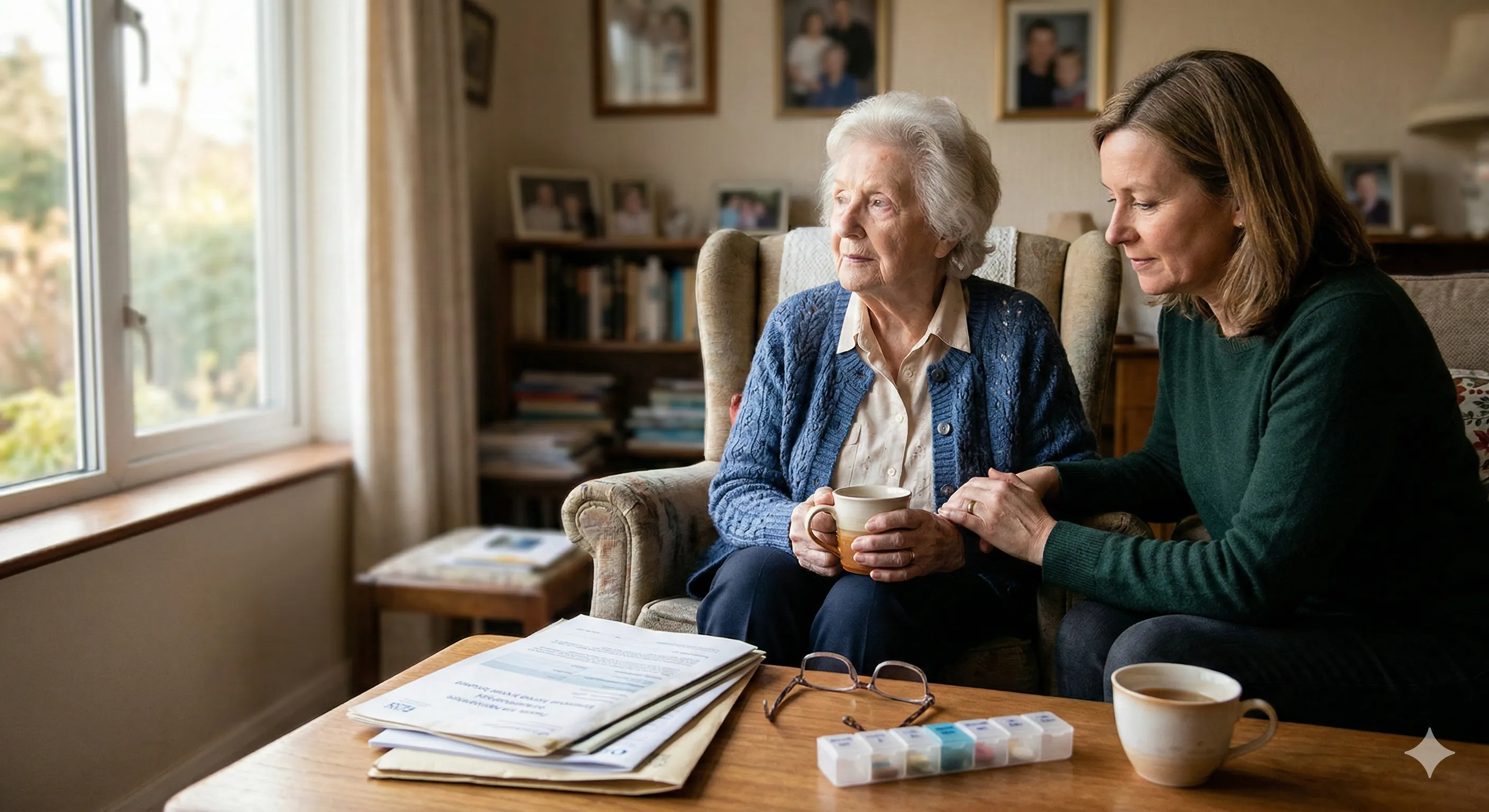
What does the reviewer assess? The same Decision Support Tool framework used at the original assessment — the same 12 domains, the same descriptors. That symmetry cuts both ways. If your relative's condition has stabilised because of good care, a reviewer can read that stability as "reduced need" and propose removing funding. It's the well-managed needs trap, and it sinks more reviews than any sudden improvement does.
So review preparation matters as much as the first assessment. Bring an updated evidence pack — recent incident logs, medication changes, any deteriorations — and be ready to show that stability depends on the care package, not that the underlying need has gone. If CHC is withdrawn, the same appeal routes apply, and the first 48 hours of a challenge set the tone. For the full process, see the annual review process in detail.
The PUPoC Route: Retrospective Claims for Past Care
PUPoC — a Previously Unassessed Period of Care — recovers care fees paid since 1 April 2012 for periods when no CHC assessment was offered. ICBs must resolve claims covering under one year within 6 months, and longer periods under a 12-month long-stop (gov.uk, December 2023). It runs alongside the live pathway, not within it — a separate door for money already spent.
Who can claim? The person themselves, or — importantly — the estate of a deceased relative, since a paid-for period of care doesn't lose its eligibility just because the person has died. The claim is assessed against the same primary health need test that applies today, reconstructed from contemporary records: GP notes, care home daily logs, hospital records, and proof of who actually paid. Where records are thin, the claim is harder, which is why early record-gathering matters.
How big can a PUPoC reach? The historical context shows the scale. The previous 2012 close-down generated roughly 63,000 retrospective requests (Mills & Reeve, January 2024). For a family that paid £52,000+ a year self-funded since 2012, the cumulative recoverable sum can run into hundreds of thousands of pounds. For who can claim, how far back, and the evidence that wins, see the full retrospective CHC claims guide.
What's Changed in 2026: ICB Mergers, NHS England Abolition, AACC Data
Three structural changes reshaped the pathway's plumbing this year. From 1 April 2026, a wave of ICB mergers reduced the number of commissioning bodies — a change that can alter which body holds your CHC application, who your appeal contact is, and which commissioning route applies (NHS England, 2026). If your ICB's name or contact has changed mid-application, that's why.
The second change is the abolition of NHS England as a standalone body, with its functions folding into the Department of Health and Social Care through 2026 and 2027. For families, the practical effect is transitional: the bodies that administer the IRP and publish CHC data are being restructured, so contact points and publication formats are in flux. For what the mergers mean on the ground, see what the ICB mergers mean for CHC.
The third change is data. On 14 May 2026 NHS England discontinued the quarterly CHC Statistical Release and Report PDFs; the numbers don't vanish — they continue to publish quarterly as Management Information XLSX on the same statistics page, just without the NHS-authored commentary. The often-cited All Age Continuing Care (AACC) dataset is a separate, still-in-development collection — it has not yet replaced the existing CHC and FNC series. See what actually changed when NHS discontinued the CHC press release. Layered on top, the Casey Commission has signalled a review of continuing care as part of wider social-care reform — read the Casey Commission's CHC review. None of the top-ranking competitor guides mention any of these four.
The Postcode Lottery: Why Where You Live Shapes Your CHC Outcome
There is an almost five-fold difference between the English ICBs with the highest and lowest rates of CHC eligibility — the number of adults found eligible ranged from 20 to 95 per 50,000 between ICBs at 31 December 2024 (Nuffield Trust, September 2025). Spend per recipient ranges from £47,300 in the most-deprived ICBs to £95,085 in the least-deprived, against an England average of £65,012 a year. The same legal test produces wildly different odds depending on the postcode.
The gap is starker still when you measure the assessment itself rather than the population. In January–March 2026, 35.37% of people assessed for standard CHC in Cambridgeshire & Peterborough were found eligible. In Gloucestershire, 2.26% were (King's Fund, June 2026). Same National Framework, same Coughlan test, same quarter — and a fifteen-fold difference in the odds of a yes.
Why does that matter for your case? Because it tells you a refusal may say as much about your ICB as about your relative's needs. If your area sits in the bottom band for eligibility, that's context for a challenge — not proof you're wrong. Care England's summary of the Nuffield findings underlines that demographics account for under a quarter of the gap (Care England, 2025), which means most of the variation is about local practice, not local need.
What can families do about it? Two things. Ask for a named CHC coordinator so you have a single accountable contact, and benchmark any refusal against your ICB's published eligibility rate — a low-band ICB refusing a strong case is exactly the pattern an appeal is designed to test. For the numbers by area, see CHC eligibility rates by ICB and the CHC postcode lottery in detail.
One honest note on the data. NHS England does not publish a national IRP success rate, nor national PUPoC claim volumes. Anyone quoting precise figures for either is estimating. Naming that gap is part of using the pathway with clear eyes — the published numbers tell you a great deal about Stages 1 to 3, and very little about how often Stage 4 ultimately succeeds.
Conclusion
The CHC pathway looks like a maze on the way in and a map on the way out. Five stages, one retrospective route, and a handful of points where families quietly lose entitlement. Hold on to these:
- The five stages: Checklist → MDT/DST → Outcome → Appeal → Annual Review, with PUPoC running alongside for past care.
- The five silent traps: annual-review withdrawal; the PUPoC long-stop; Fast Track misuse; refusal letters that omit appeal routes; and PHB confused with eligibility.
- A refusal is now normal, not final. With standard eligibility at 16.65%, most cases are refused — and roughly one in seven first-stage challenges still succeeds on the same evidence.
- Evidence wins at every stage. The same records carry different weight at Checklist, DST, appeal, and PUPoC — preparing them is the work.
- Where you live shapes your odds — 2.26% to 35.37% between ICBs in the same quarter — so benchmark any refusal against your area.
If you're at the Checklist stage and want to know how strong your evidence is before you sit down with the assessors, our Case Strength Report reviews your relative's medical records against the National Framework — so you walk into Stage 2 knowing what the records actually say. Most refusals are systemic, not personal. The pathway is winnable with the right evidence at each stage — and that's the whole job.
Reviewed by legal professionals and social care professionals.
Frequently asked questions
What are the stages of the NHS CHC process?
The NHS Continuing Healthcare process runs as five stages: the Checklist (Stage 1 screen), the full MDT assessment using the Decision Support Tool (Stage 2), the ICB outcome decision (Stage 3), a two-stage appeal of Local Resolution then Independent Review Panel (Stage 4), and Annual Review (Stage 5). A separate PUPoC route recovers fees for past care back to 1 April 2012 ([gov.uk](https://www.gov.uk/government/publications/continuing-healthcare-previously-unassessed-periods-of-care), 2023).
How long does a CHC application take?
The statutory target is 28 days from a positive Checklist to a full assessment decision. National performance was 77% against that target in Q3 2025/26 — 13,123 of 17,087 completed standard referrals, still below the 80% ICB assurance standard ([NHS England](https://www.england.nhs.uk/statistics/wp-content/uploads/sites/2/2026/02/CHC-and-FNC-Report-Q3-2025-26-TQ68n.pdf), February 2026). End to end — Checklist through to an Independent Review Panel — a contested case can run 18 months or longer.
What is the CHC Checklist and who completes it?
The CHC Checklist is a Stage 1 screening tool, not an eligibility decision. Any health or social care professional — a nurse, GP, social worker, or care home staff member — can complete one when needs change or a person deteriorates. A positive Checklist triggers a referral to full assessment; it does not, on its own, award funding ([gov.uk](https://www.gov.uk/government/publications/national-framework-for-nhs-continuing-healthcare-and-nhs-funded-nursing-care), 2022).
What happens after a positive CHC Checklist?
A positive Checklist triggers Stage 2: a full assessment by a Multi-Disciplinary Team using the Decision Support Tool, which scores 12 care domains. The statutory target is 28 days from Checklist to decision. The MDT makes a recommendation; the Integrated Care Board makes the final eligibility decision and must give reasons in writing ([gov.uk](https://www.gov.uk/government/publications/national-framework-for-nhs-continuing-healthcare-and-nhs-funded-nursing-care), 2022).
Can NHS Continuing Healthcare be withdrawn at the annual review?
Yes. Every CHC-eligible person is reviewed at least annually, and eligibility is reassessed against the same Decision Support Tool framework used at the original assessment. If the reviewer concludes needs have changed, CHC can be removed — which makes review preparation as important as the first assessment ([gov.uk](https://www.gov.uk/government/publications/national-framework-for-nhs-continuing-healthcare-and-nhs-funded-nursing-care), 2022). The family can challenge a withdrawal through the same appeal routes.
Can I claim CHC funding retrospectively for care already paid for?
Yes — through the PUPoC (Previously Unassessed Period of Care) route, which recovers care fees paid since 1 April 2012 for periods when no CHC assessment was offered. ICBs must resolve claims under one year within 6 months, and longer periods within a 12-month long-stop ([gov.uk](https://www.gov.uk/government/publications/continuing-healthcare-previously-unassessed-periods-of-care), 2023). Estates of deceased relatives can also claim.